Getty Museum
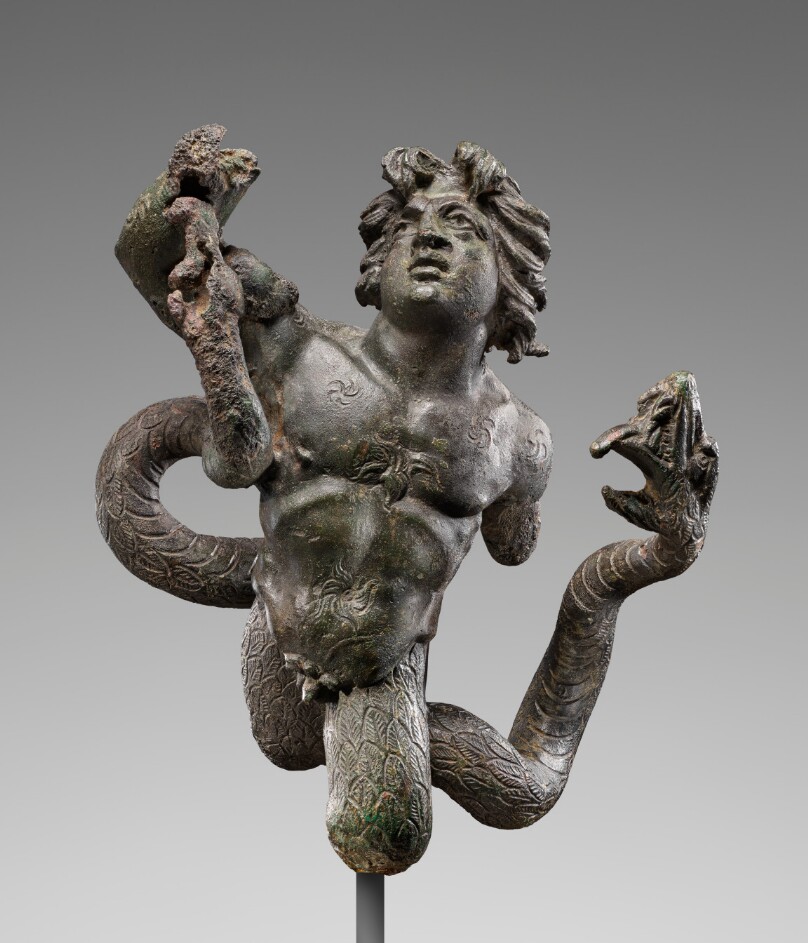
Statuette of a Snake-legged Giant
Creator
UnknownAll works by this person →More on Getty ULAN- Date
- A.D. 180–220
- Medium
- Bronze
- Culture
- Roman
- Department
- Sculpture
- Institution
- Getty Museum
- Object ID
- 6d23a654-3614-4c7c-a965-afc1ece4dec8
From the Getty Museum record
In Greek mythology the giants, children of Ge (Earth) and Uranus (Sky), tried to overthrow the Olympian gods in a mighty battle. This young giant, identified by his snaky legs, was originally shown in combat with a now-missing opponent. He raises his right arm, wrapped in an animal skin, to ward off a blow. The giant's unkempt hair and the clumps of body hair sprouting from his chest, belly, and shoulders emphasize his wildness and barbarity. The battle between the Olympian gods and the giants was extremely popular in Greek art; after the Persian War, it became an allegory for battles between Greeks and barbarians. The giant's twisting pose, the intense pathos of his expression, and the choice of the subject itself were deeply influenced by the style of art developed in the Greek city of Pergamon in the 100s B.C., a style that saw a resurgence in Roman art of the late 100s A.D. This figure may originally have been part of a large group depicting the battle. In the Roman period, groups of small bronzes were often used as decorative elements on objects such as furniture or chariots; the attachment hole on the giant's "knee" suggests this usage.
The authoritative record is held by Getty Museum. LinkedCulture surfaces this object and its connections; it does not alter institutional metadata.
Get printable QR codesHide QR codes
Open QR codes for this object page and the museum record. They stay collapsed until needed.
Related across collections
Semantically similar works from Getty Museum and other institutions.