Getty Museum
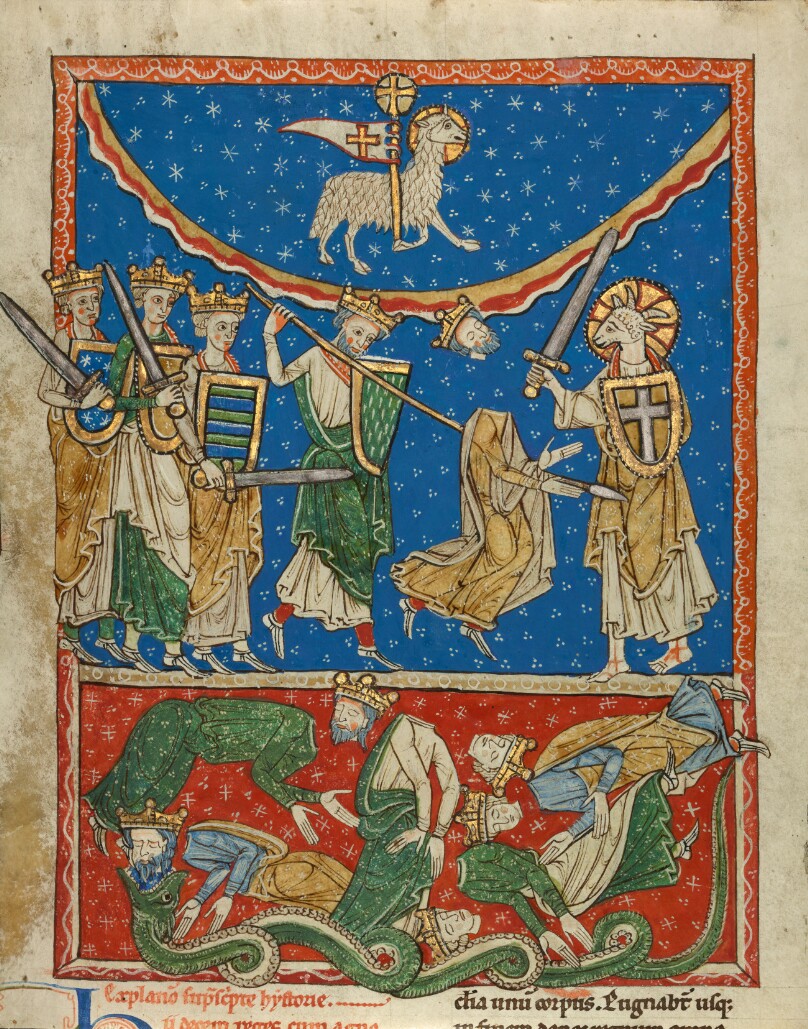
The Lamb Defeating the Ten Kings
Creator
UnknownAll works by this person →More on Getty ULAN- Date
- about 1220–1235
- Medium
- Tempera colors and gold leaf
- Culture
- Spanish
- Department
- Manuscripts
- Institution
- Getty Museum
- Object ID
- 7362e2d4-9e0f-44e1-8349-7ba8b39e3779
From the Getty Museum record
This miniature once formed part of a lavishly illustrated manuscript containing a commentary by Beatus of Liébana on the Bible's highly enigmatic text concerning the end of the world. The portion of the Apocalypse it originally illustrated describes a vision of a great battle taking place between the Lamb of God and ten kings who personify the ten horns of the beast the Harlot of Babylon rides. In the upper register, the Lamb decapitates each king as he approaches, while in the lower compartment a writhing serpent begins to devour the corpses of the kings who have already encountered the Lamb. The illumination is unusual for its balanced combination of elegant forms and gruesome subject matter. Beatus of Liébana's Latin *Commentary on the Apocalypse (Commentarius in Apocalypsim)* was one of the most influential medieval commentaries on the final book of the New Testament. Beatus paired short passages from the Apocalypse with interpretations of the texts as Christian allegories. At the height of its popularity from the 900s to the 1200s, Beatus's commentary was the most heavily illuminated text produced in Spain. The illustrated Beatus as a type has, in fact, become so thoroughly associated with illumination from the region that it is practically a hallmark for Spanish illumination as a whole.
The authoritative record is held by Getty Museum. LinkedCulture surfaces this object and its connections; it does not alter institutional metadata.
Get printable QR codesHide QR codes
Open QR codes for this object page and the museum record. They stay collapsed until needed.
Related across collections
Semantically similar works from Getty Museum and other institutions.