Getty Museum
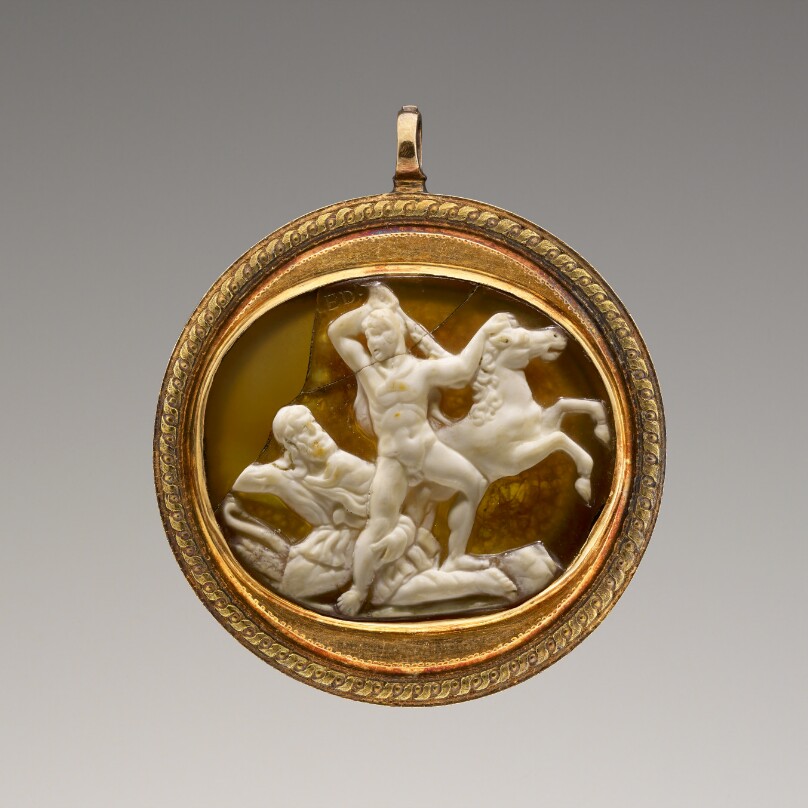
Cameo with Hercules and Diomedes
Creator
UnknownAll works by this person →More on Getty ULAN- Date
- 25 B.C. – A.D. 14
- Medium
- Cameo: sardonyx; modern mount: gold
- Culture
- Roman
- Department
- Jewelry
- Institution
- Getty Museum
- Object ID
- 737fed84-0244-41d8-b741-f72f15f886d7
From the Getty Museum record
The cameo is carved from an amber-colored stone (sardonyx) that has a white upper layer. At the center, Hercules accomplishes his eighth Labor – capturing the flesh-eating horses of Diomedes, king of Thrace. The hero stands frontally, grasping the mane of a rearing horse with his left hand, while brandishing his club over Diomedes, who collapses on his knees at left. Hercules’ nude body is carefully articulated to emphasize his musculature, and a lionskin knotted over his chest covers his head. He is beardless, in contrast to Diomedes, who grasps Hercules’s right leg with his left hand. The defeated king wears trousers and a cap, and has a sword in its scabbard at his hip. He extends his right arm (now missing), and a bow and quiver containing two arrows lies on the ground at left. The cameo was once in the famed collection of Lorenzo de‘ Medici (1449-1492) in Florence. Lorenzo’s ownership mark is partially preserved in Latin above Hercules. The copper-rich gold pendant in which the cameo is set has a decorative guilloche border, and dates to the nineteenth century.
The authoritative record is held by Getty Museum. LinkedCulture surfaces this object and its connections; it does not alter institutional metadata.
Get printable QR codesHide QR codes
Open QR codes for this object page and the museum record. They stay collapsed until needed.
Related across collections
Semantically similar works from Getty Museum and other institutions.