Getty Museum
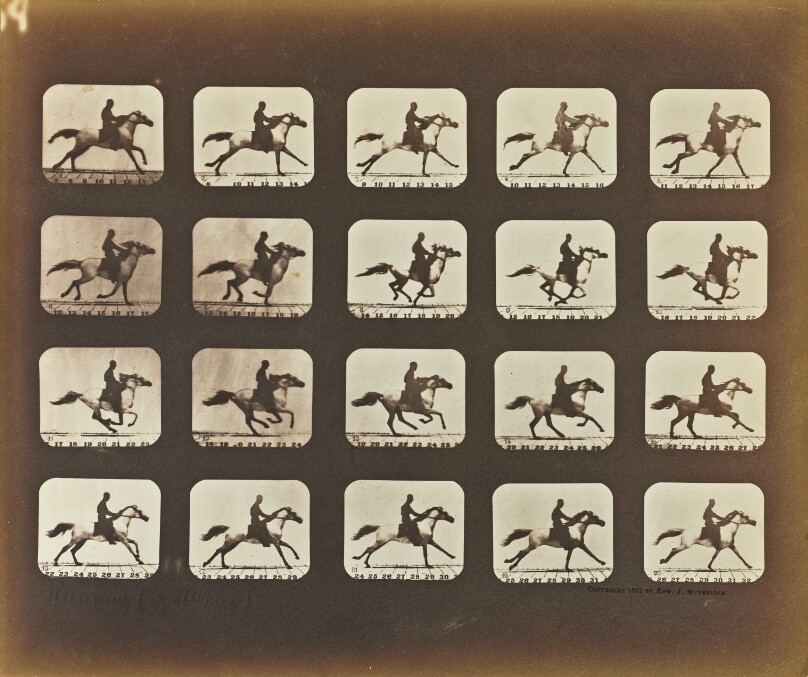
Running (Galloping)
Creator
Eadweard J. MuybridgeAmerican Photographer · 1830–1904
All works by this person →In his early twenties, Eadweard Muybridge moved to the United States, where he was drawn to the primarily uncharted Western landscape. After a stagecoach accident, he convalesced back home in England and learned photography. Upon returning to the States in 1867, he soon earned his reputation photographing the landscape. Apparently a hot-tempered man, Muybridge shot and killed his much younger wife
More on Getty ULAN- Date
- negative 1878–1879; print 1881
- Medium
- Iron salt process
- Culture
- American
- Department
- Photographs
- Institution
- Getty Museum
- Object ID
- 7386c12f-b857-4473-93ba-9a9018125c49
From the Getty Museum record
In the early 1880s Leland Stanford, an industrialist and former governor of California, commissioned Eadweard Muybridge to test a theory: that all four hoofs of a horse lift off the ground during a gallop. Muybridge devised a system for simultaneously tripping the shutters of up to twenty-four cameras arranged on a low shelf as the animal advanced across a racetrack. This test succeeded in visually halting the motion of a rapidly moving horse and proving the theory to be correct.
The authoritative record is held by Getty Museum. LinkedCulture surfaces this object and its connections; it does not alter institutional metadata.
Get printable QR codesHide QR codes
Open QR codes for this object page and the museum record. They stay collapsed until needed.
Related across collections
Semantically similar works from Getty Museum and other institutions.