Getty Museum
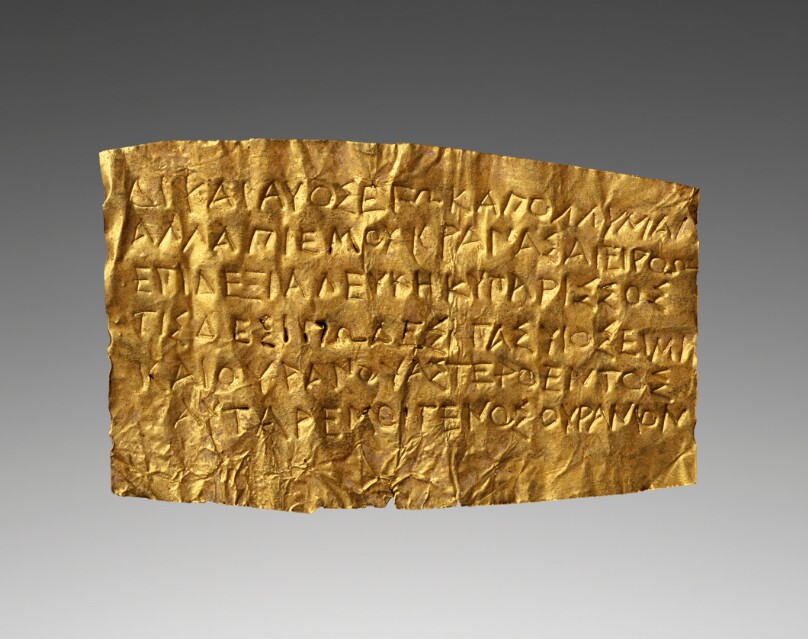
Lamella Orphica
Creator
UnknownAll works by this person →More on Getty ULAN- Date
- mid-4th century B.C.
- Medium
- Gold
- Culture
- Greek
- Department
- Texts
- Institution
- Getty Museum
- Object ID
- 7d0e9785-64a2-4f10-90de-97648214207a
From the Getty Museum record
Faced with the thought of a bleak existence in the Underworld, some individuals in the ancient Mediterranean sought to improve their lot while they were alive. Virtuous behavior might not be sufficient, and one way to obtain a happier afterlife was thought to be through initiation into mystery cults associated with Orpheus and Dionysos. Self-styled preachers offered followers transformative experiences that mainstream practice could not provide. Their rites were shrouded in secrecy and remain little understood today, but one of the most intriguing sources of information are the so-called Orphic tablets, such as this one. Named by modern scholars after the mythical poet Orpheus, these are inscriptions written on thin sheets of gold. They were deposited in graves, and usually bear a short text proclaiming the deceased’s special status and providing guidance for his or her journey into the Underworld. On this example, the text takes the form of a dialogue between the dead initiate and a spring in the Underworld: (Initiate): I am parched with thirst and perishing! (Spring): Then come drink of me, the Ever-Flowing Spring. On the right there is a bright cypress. Who are you? Where are you from? (Initiate): I am the son of Earth and Starry Heaven. But my race is heavenly. (Translation by Roy Kotansky (2017)). [Hear this recited in the original ancient Greek](https://gettyaudio.s3.amazonaws.com/museumcollection/008289-en-20190131-v1.mp3) Armed with this privileged information as to where to go in the Underworld and what to say, the deceased could feel secure in the face of death. Although the tablets like this have been found across a wide area—in Sicily and southern Italy, northern Greece, the Peloponnese, and Crete—they are exceedingly rare. Their owners were a select few, who subscribed to beliefs that would have appeared esoteric and eclectic to their contemporaries.
The authoritative record is held by Getty Museum. LinkedCulture surfaces this object and its connections; it does not alter institutional metadata.
Get printable QR codesHide QR codes
Open QR codes for this object page and the museum record. They stay collapsed until needed.
Related across collections
Semantically similar works from Getty Museum and other institutions.