Getty Museum
Antiphonal
Creator
Master of GeronaItalian Illuminator · 1300–present
All works by this person →The anonymous Master of Gerona, who derives his name from his work on the illuminations in a Bible now in Gerona, Spain, was deeply influenced by Byzantine icon painting. In particular, like many of his Italian contemporaries, he was interested in the convincing depiction of three-dimensional objects in space, one of the innovative trends that led to the later Italian Renaissance style. The Master
More on Getty ULAN- Date
- late 13th century
- Medium
- Tempera colors, gold leaf, and ink
- Culture
- Italian
- Department
- Manuscripts
- Institution
- Getty Museum
- Object ID
- 7e68ca00-cb2c-45f2-824a-9aef32be31ad
From the Getty Museum record
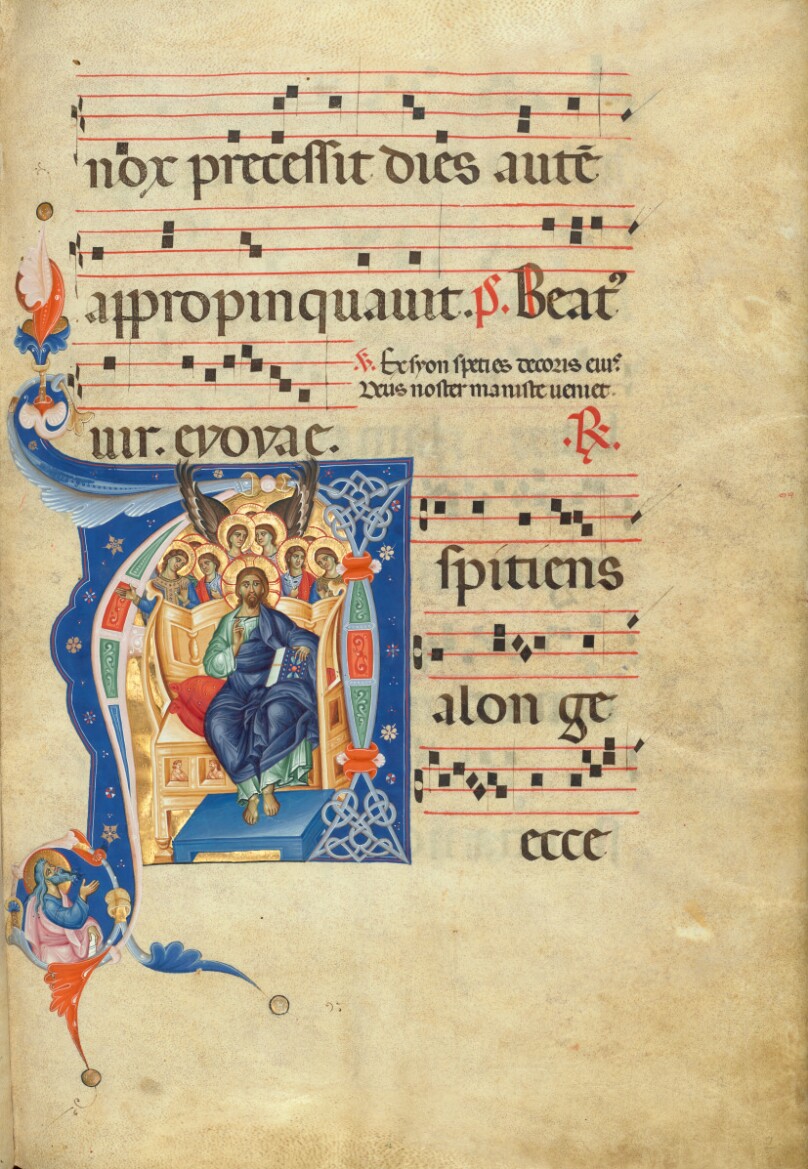
This large-scale, splendidly illuminated choir book was designed to be seen from a lectern by a group of singers during the Divine Office, the eight prayer services sung daily by monks, nuns, and clerics of the Catholic Church. The manuscript was likely produced for a community of the Dominican Order based at a church in either Bologna or Florence. It is the first volume of a type of choir book called an antiphonal that probably consisted of seven separately bound books. The illumination of the manuscript primarily takes the form of historiated initials (enlarged letters decorated with a narrative illustration) marking the major Christian festivals of the church year. The illuminator of this manuscript, known as the Master of Gerona, worked in Italy in the late 1200s, training in Bologna. Familiar with Byzantine icon painting as well as recent trends in Italian panel painting, the artist succeeded in conveying an impressive sense of weight, volume, and depth to the figures. For example, while the face of Christ in the initial *A* of folio 2 clearly recalls a Byzantine icon, the evocation of space in the placement of Christ, throne, and the angels points to the influence of the Italian painter, Cimabue (about 1240-1302).
The authoritative record is held by Getty Museum. LinkedCulture surfaces this object and its connections; it does not alter institutional metadata.
Get printable QR codesHide QR codes
Open QR codes for this object page and the museum record. They stay collapsed until needed.
Related across collections
Semantically similar works from Getty Museum and other institutions.