Getty Museum
Book of Hours
Creator
UnknownAll works by this person →More on Getty ULAN- Date
- early 16th century
- Medium
- Tempera colors
- Culture
- German
- Department
- Manuscripts
- Institution
- Getty Museum
- Object ID
- 88918a3e-ab31-4285-93f1-c7927026971b
From the Getty Museum record
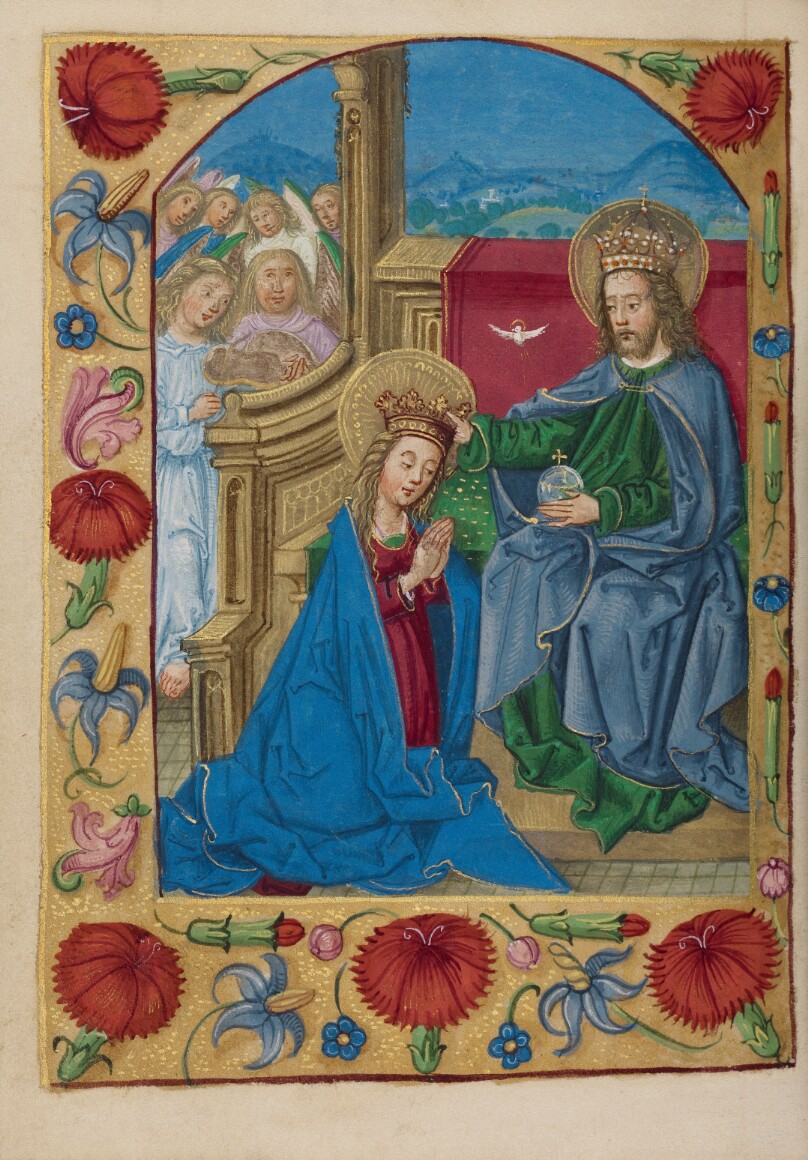
This sumptuously illuminated French book of hours presents a rich program of prayers and images for private Christian devotion. A book of hours, the most popular type of medieval devotional manuscript, provided the faithful with prayers, psalms, and hymns arranged for recitation at specific times of each day. This manuscript opens with a complete calendar where each month is illustrated by a half-page scene that combines a seasonal labor with an astrological sign, uniting two systems of marking time within a single naturalistic landscape. Compared to other books of hours of this time, the calendar’s illustrations are large and vibrantly colored, dominating the page and setting the tone for the manuscript’s rich pictorial program. The manuscript includes several standard textual components often found in books of hours, including the Seven Penitential Psalms and the Office of the Dead. More unusual is the dispersed arrangement of texts recounting Christ’s Passion (the events leading up to his death), drawn from the four Gospels of the Christian New Testament and interwoven with specific Offices assigned to days of the week, such as the Saturday Office of the Virgin Mary. Each major section begins with a full-page miniature (nineteen in all), most depicting episodes from the life of the Virgin Mary, the life and Passion of Christ, and portraits of the four Evangelists. The compositional arrangement of several miniatures, including the Visitation, Nativity, and Coronation of the Virgin, suggests that the illuminator, whose name is unknown, may have drawn inspiration from prints and drawings by artists living at the same time, including Albrecht Dürer (German, 1471-1528) and Martin Schongauer (German, about 1450/53-1491). This phenomenon testifies to the dynamic interplay between manuscript illumination and print culture at the end of the Middle Ages. Characteristic of the finest French and Flemish books of hours from the late fifteenth and early sixteenth centuries, many pages in this manuscript are framed with exquisite borders filled with flowers, fruits, humans, animals, and fantastical creatures, on brightly colored or shimmering gold grounds. Rendered with striking naturalism and a sense of three-dimensionality enhanced by the use of shadows, motifs such as strawberries, roses, cornflowers, daisies, peas, and acanthus leaves create a suggestion of depth, producing the illusion that the border appears closer to the viewer while the central miniature recedes into the distance, thereby drawing the viewer’s focus toward the central scene. These border motifs are not merely decorative but carry symbolic and theological meaning. Together, text, image, and border decoration offer a richly layered framework designed to guide the reader-viewer in meditative contemplation of Christianity’s central themes and narratives, especially Christ’s Passion.
The authoritative record is held by Getty Museum. LinkedCulture surfaces this object and its connections; it does not alter institutional metadata.
Get printable QR codesHide QR codes
Open QR codes for this object page and the museum record. They stay collapsed until needed.
Related across collections
Semantically similar works from Getty Museum and other institutions.