Getty Museum
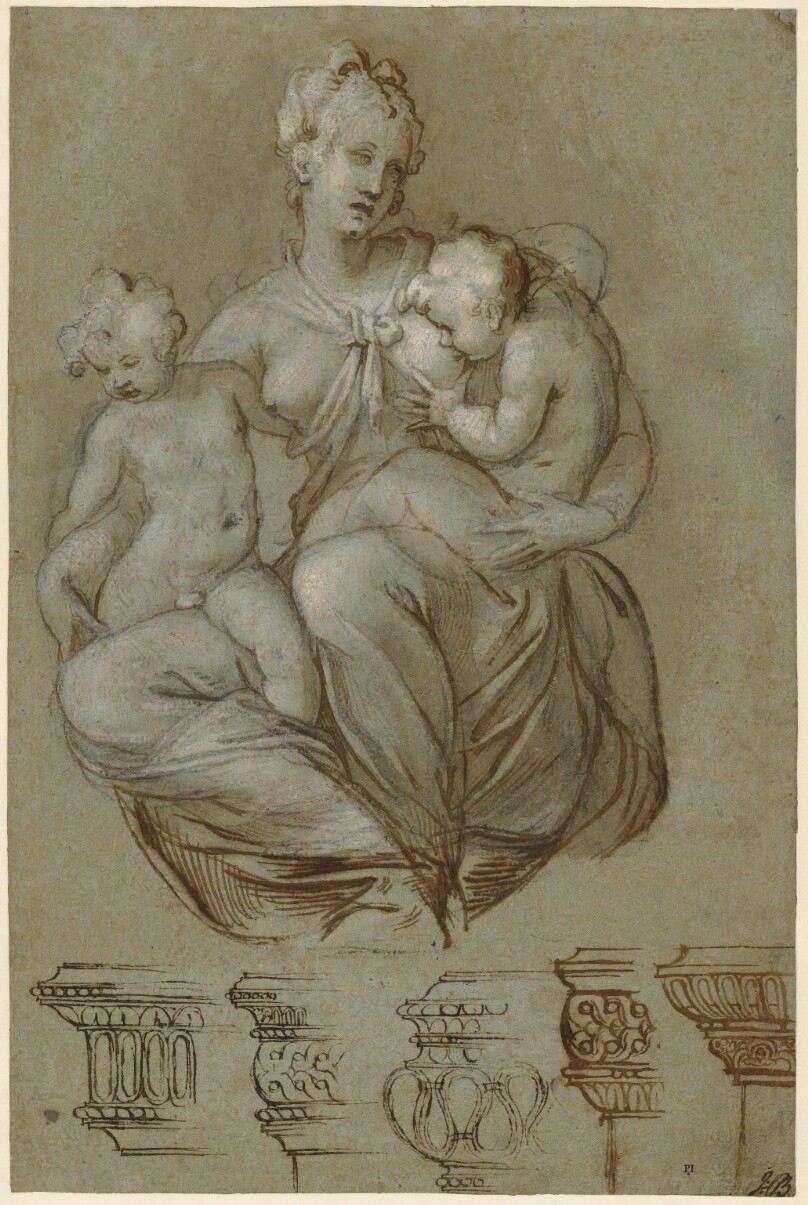
Charity and Studies of Entablatures (recto); Frieze of Putti (verso)
Creator
Paolo FarinatiItalian Artist · 1524–1606
All works by this person →Although he was a painter's son, Paolo Farinati trained under another local painter, according to Giorgio Vasari. His master's eccentric manner encouraged Farinati to emphasize line over color and to restrict his palette to grays, browns, mauve, and rust. Farinati worked mostly in his native Verona, but a 1552 painting commission for the Mantua Cathedral altered his approach. In Mantua, Farinati s
More on Getty ULAN- Date
- about 1580
- Medium
- Brown ink and brown wash over black chalk, heightened with white opaque watercolor (recto); black chalk with pen and brown ink (verso), on blue paper (now discolored)
- Culture
- Italian
- Department
- Drawings
- Institution
- Getty Museum
- Object ID
- 8c12dade-cd6e-48c6-b1c2-3437236821c1
From the Getty Museum record
In the 1300s a woman suckling two children became the standard image of Charity, one of the three Virtues. Here the figure of Charity holds two putti on her lap. One suckles her breast, while the other twists around to look down at her knee. Paolo Farinati used delicate lines, areas of wash, and touches of white bodycolor to build each figure's form. Using brown ink, he outlined Charity and added dark, parallel lines of hatching to create shadows and highlights on her robe. As an afterthought, he made changes to the suckling putto's leg and added his right arm. He may have used the column capitals along the bottom and the frieze of putti on the verso as sources of motifs for the many decorative frescoes that he painted in local villas.
The authoritative record is held by Getty Museum. LinkedCulture surfaces this object and its connections; it does not alter institutional metadata.
Get printable QR codesHide QR codes
Open QR codes for this object page and the museum record. They stay collapsed until needed.
Related across collections
Semantically similar works from Getty Museum and other institutions.