Getty Museum
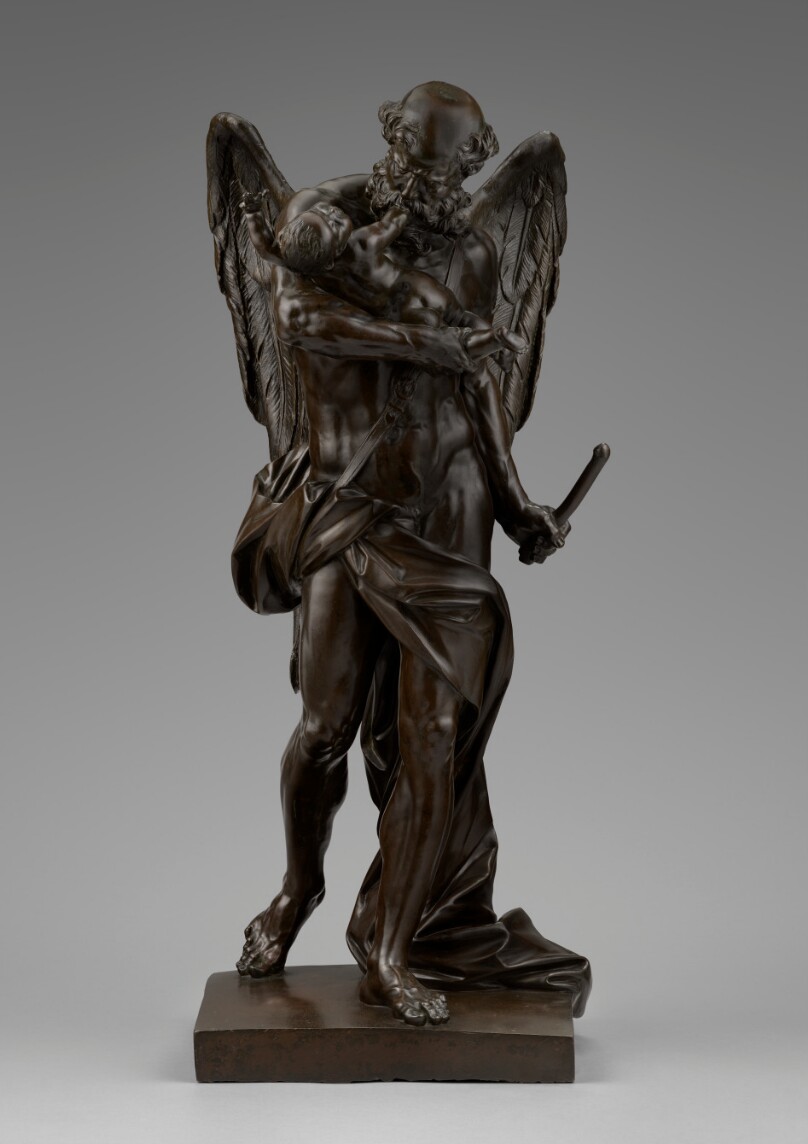
Saturn Devouring One of His Children
Creator
Simon HurtrelleFrench Artist · 1648–1724
All works by this person →Continuing in his father's profession as a sculptor, Simon Hurtrelle took advantage of the new opportunities offered by the Académie Royale to study in Rome. From 1673 to 1682 he was a *pensionnaire,* akin to a scholarship student, at the Académie de France in Rome. Considered one of the "most capable" of the Académie students in Rome, he was admitted to the prestigious Italian Accademia di San Lu
More on Getty ULAN- Date
- about 1700
- Medium
- Bronze
- Culture
- French
- Department
- Sculpture
- Institution
- Getty Museum
- Object ID
- 96c32b62-9df6-44dd-9c5c-c090e173c6c4
From the Getty Museum record
Saturn, one of the Titans who once ruled earth in Roman mythology, devours the infant child he holds in his arm. According to a prophecy, Saturn would be overthrown by one of his sons. In response, he ate his sons as soon as they were born. But the mother of his children, Rhea, hid one child, Jupiter. Later, Jupiter gave his father a potion, forcing him to regurgitate his siblings; he then vanquished his father and ruled over earth, fulfilling the prophecy. Saturn's cannibalism is graphically shown here: in his left hand he holds a bone from one of his already eaten children while he partially ingests the child in his arm. Simon Hurtrelle represented Saturn as a powerful, yet elderly figure with wings. The wings suggest the speed of time and derive from the association of Saturn, also known as Cronos, with the Greek god of time, Chronus. Similarly, Saturn's loss of hair indicates the passing of time. The composition of the bronze was inspired by an antique Roman marble sculpture that Hurtrelle saw in Rome.
The authoritative record is held by Getty Museum. LinkedCulture surfaces this object and its connections; it does not alter institutional metadata.
Get printable QR codesHide QR codes
Open QR codes for this object page and the museum record. They stay collapsed until needed.
Related across collections
Semantically similar works from Getty Museum and other institutions.