Getty Museum
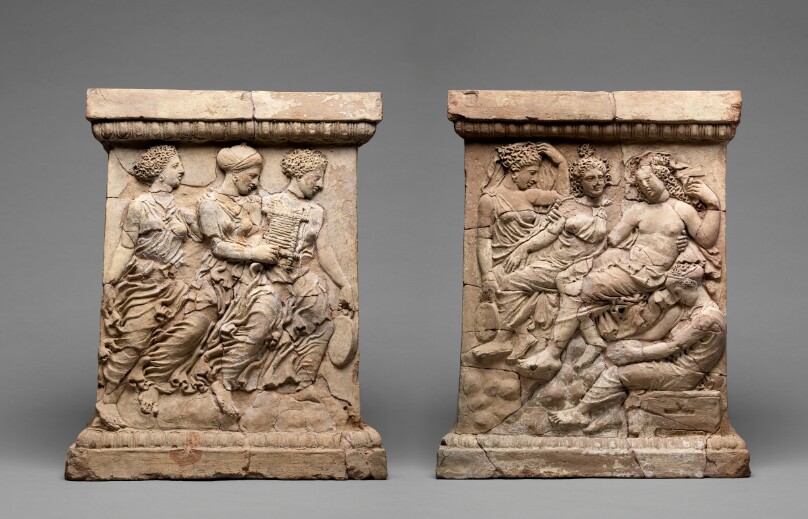
Pair of Altars with Relief Decoration
Creator
UnknownAll works by this person →More on Getty ULAN- Date
- first quarter of 4th century B.C.
- Medium
- Terracotta
- Culture
- Greek (South Italian)
- Department
- Implements
- Institution
- Getty Museum
- Object ID
- 99240882-d40b-487b-8a17-5070adcd4557
From the Getty Museum record
This pair of terracotta altars depicts the death of Adonis, a god of vegetation, and the rituals that were celebrated in his honor. On the altar on the right, Adonis, looking weak, sits supported in the arms of his lover Aphrodite, the goddess of love. Adonis was born of an incestuous love between the Assyrian king Theias and his daughter Myrrha; Aphrodite was smitten by the infant Adonis's great beauty and hid him in a box (*cista*), which she entrusted to Persephone. When Persephone opened the box, she too fell in love with the beautiful infant and decided not to give him back to Aphrodite. Zeus interceded in the quarrel between the two goddesses and ordered that Adonis should spend a third of the year with Aphrodite, a third with Persephone, and the last third wherever he liked— Adonis chose to devote that time to Aphrodite as well. The woman at bottom right, sitting on the box, is likely to be Persephone. On the left altar, three women rush to the scene, carrying musical instruments: a tympanum, or drum, and a xylophone. Small terracotta altars such as these would have been used for private worship, perhaps to burn incense. This pair still bears traces of burning on its upper surfaces, as well as pigment used for decorating the relief figures. Stylistic features of the figures and their drapery, as well as the type of clay that was used, suggest that the altars were made in Medma, in Southern Italy.
The authoritative record is held by Getty Museum. LinkedCulture surfaces this object and its connections; it does not alter institutional metadata.
Get printable QR codesHide QR codes
Open QR codes for this object page and the museum record. They stay collapsed until needed.
Related across collections
Semantically similar works from Getty Museum and other institutions.