Getty Museum
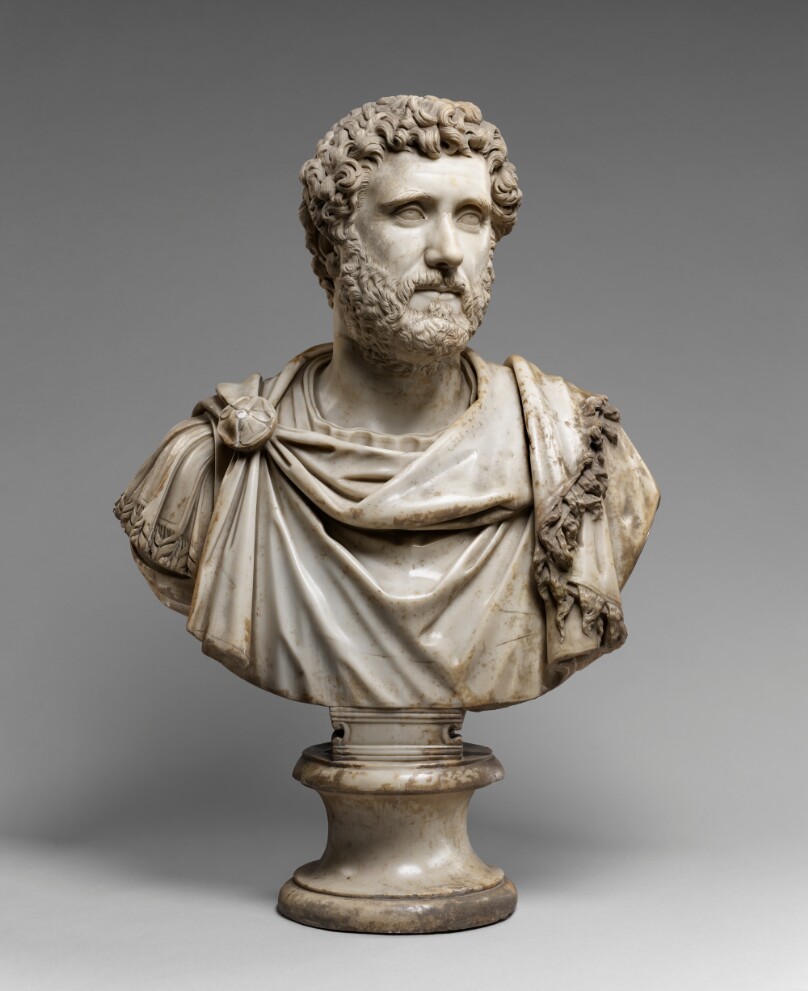
Portrait Bust of Emperor Antoninus Pius
Creator
UnknownAll works by this person →More on Getty ULAN- Date
- A.D. 140–160
- Medium
- Marble
- Culture
- Roman
- Department
- Sculpture
- Institution
- Getty Museum
- Object ID
- 9a5bb6a1-d209-4bed-83e7-8702b41bcc3d
From the Getty Museum record
This over life-size bust of the Roman emperor Antoninus Pius (ruled AD 138-161) was carved from a single block of fine-grained white marble. The emperor is shown as a mature man, with a full, neatly trimmed beard and a dense mass of curly hair. His distinct facial features include the furrows across the forehead, curved and bushy eyebrows, deep-set eyes with incised irises and pupils, and the soft flesh on the cheeks with pronounced nasolabial folds. The emperor is presented wearing three pieces of garments—a tunic, visible only at the neckline; a cuirass, recognizable by the fringed leather strips covering the right shoulder and by a part of the right epomis, the armor’s shoulder strap; and finally, the paludamentum, a “general’s cloak” folded in half, draped over the left shoulder and fastened with a rosette-shaped button on the right shoulder. The physiognomy of Antoninus Pius, known from his coinage and also attested by the Vatican relief base celebrating his and his wife Faustina’s apotheosis, is unmistakable and since the Renaissance has never been confused with the faces of other individuals. Today, some one hundred sculpted portraits of Antoninus are known, a relatively small number given that he was in power for twenty-three years and that imperial images were distributed across a vast empire at a time when it was close to its largest extent. Titus Aelius Caesar Hadrianus Antoninus Augustus Pius (AD 86-161) was not groomed to become emperor. At the advanced age of 51, following a career as governor of the province of Asia and as a Roman senator, he was adopted by Emperor Hadrian as his successor and ruled the empire until his death in AD 161. The prototype for his official portrait was created on the occasion of his accession. This type remained current throughout Antoninus’ reign, and the image’s longevity is symbolic of the long period of stability and calm the Roman Empire experienced under his rule.
The authoritative record is held by Getty Museum. LinkedCulture surfaces this object and its connections; it does not alter institutional metadata.
Get printable QR codesHide QR codes
Open QR codes for this object page and the museum record. They stay collapsed until needed.
Related across collections
Semantically similar works from Getty Museum and other institutions.