Getty Museum
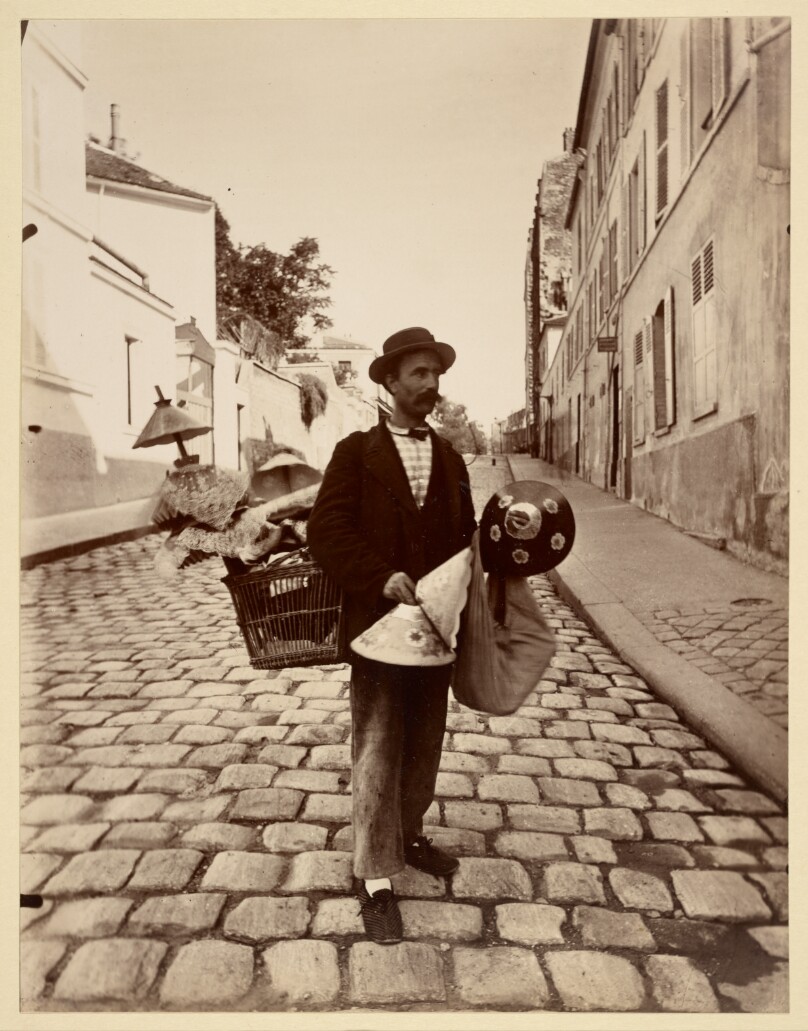
Marchand d'Abat-Jours
Creator
Eugène AtgetFrench Photographer · 1857–1927
All works by this person →Eugène Atget never called himself a photographer; instead he preferred "author-producer." A private, almost reclusive man, Atget first tried his hand at painting and acting, then began to photograph *vieux Paris* (Old Paris) in 1898. He photographed in part to create "documents," as he called his photographs, of architecture and urban views, but he supported himself by selling these photographs to
More on Getty ULAN- Date
- 1899–1900
- Medium
- Albumen silver print
- Culture
- French
- Department
- Photographs
- Institution
- Getty Museum
- Object ID
- 9af55b30-7b99-41d5-8d29-2f40437c679e
From the Getty Museum record
> When Eugène Atget turned his attention to photographing *les petits métiers* (street tradespeople), he was adhering to a long iconic tradition in French graphic arts. Artists like [Abraham Bosse](https://art.famsf.org/abraham-bosse/milk-vendor-series-cries-paris-19633031277) in the seventeenth century, [Edmé Bouchardon](https://www.metmuseum.org/art/collection/search/359899?searchField=All&sortBy=Relevance&ft=Edm%c3%a9+Bouchardon&offset=40&rpp=20&pos=56) in the eighteenth century, and [Carle Vernet](https://www.metmuseum.org/art/collection/search/811408?searchField=All&sortBy=Relevance&ft=carle+vernet&offset=0&rpp=20&pos=8) in the nineteenth century took these outdoor sellers as subjects for their engravings, etchings, and lithographs. Nineteenth-century photographers like Charles Nègre (see also [84.XM.344.1](https://www.getty.edu/art/collection/objects/38320/charles-negre-organ-grinder-at-21-quai-bourbon-ile-saint-louis-paris-french-before-march-or-may-1853/) and [84.XM.692.13](https://www.getty.edu/art/collection/objects/41968/charles-negre-group-of-three-italian-street-musicians-in-front-of-21-quai-bourbon-paris-french-negative-about-1854-print-april-1982/)) and Humbert de Molard also made images of such tradespeople, as did photographers of Atget's generation, like [Paul Géniaux](https://www.musee-orsay.fr/fr/collections/catalogue-des-oeuvres/resultat-collection.html?no_cache=1&zoom=1&tx_damzoom_pi1%5Bzoom%5D=0&tx_damzoom_pi1%5BxmlId%5D=087660&tx_damzoom_pi1%5Bback%5D=fr%2Fcollections%2Fcatalogue-des-oeuvres%2Fresultat-collection.html%3Fno_cache%3D1%26zsz%3D9) and Louis Vert, but Atget was more thorough, portraying a larger variety of peddlers. As their livelihood depended upon their not going unnoticed, these inherently picturesque hawkers with their singsong street cries were available and seemingly willing subjects. > > This vendor of lampshades in the streets of Montmartre is typical of these tradespeople, who also included [ragpickers](https://www.getty.edu/art/collection/objects/64726/eugene-atget-chiffonier-french-1899-1901/), knife sharpeners, window washers, dispensers of coconut milk, and sellers of baskets, herbs, candy, and [plaster statues](https://www.getty.edu/art/collection/objects/63515/eugene-atget-le-petit-italien-marchand-de-statuettes-italian-statue-vendor-french-1899-1900/). (The lampshades he displays were intended for gas lamps, not electrical fixtures, which explains their uniformly small scale.) Atget's series of works depicting these individuals was made over a short span of years, from 1899 to 1901, but unlike his other series, he did not revisit this one. As he intended, artists used some of the images as sources for works in other media. Additionally, about 1904 a Parisian publisher released a set of eighty postcards of Atget's photographs of petits métiers, a unique occurrence of the wholesale commercial adoption of his pictures. ([See an example of Atget’s postcards at the Museum of Fine Arts, Boston.](https://collections.mfa.org/objects/582553/marchand-de-marrons--chauds-chauds-les-marrons?ctx=166d2834-34c7-4907-93f0-13ef7a0f0255&idx=12)) > > Originally published in *Eugène Atget*, In Focus: Photographs from the J. Paul Getty Museum by Gordon Baldwin (Los Angeles: J. Paul Getty Museum, 2000), 22. ©2000, J. Paul Getty Trust.
The authoritative record is held by Getty Museum. LinkedCulture surfaces this object and its connections; it does not alter institutional metadata.
Get printable QR codesHide QR codes
Open QR codes for this object page and the museum record. They stay collapsed until needed.
Related across collections
Semantically similar works from Getty Museum and other institutions.