Getty Museum
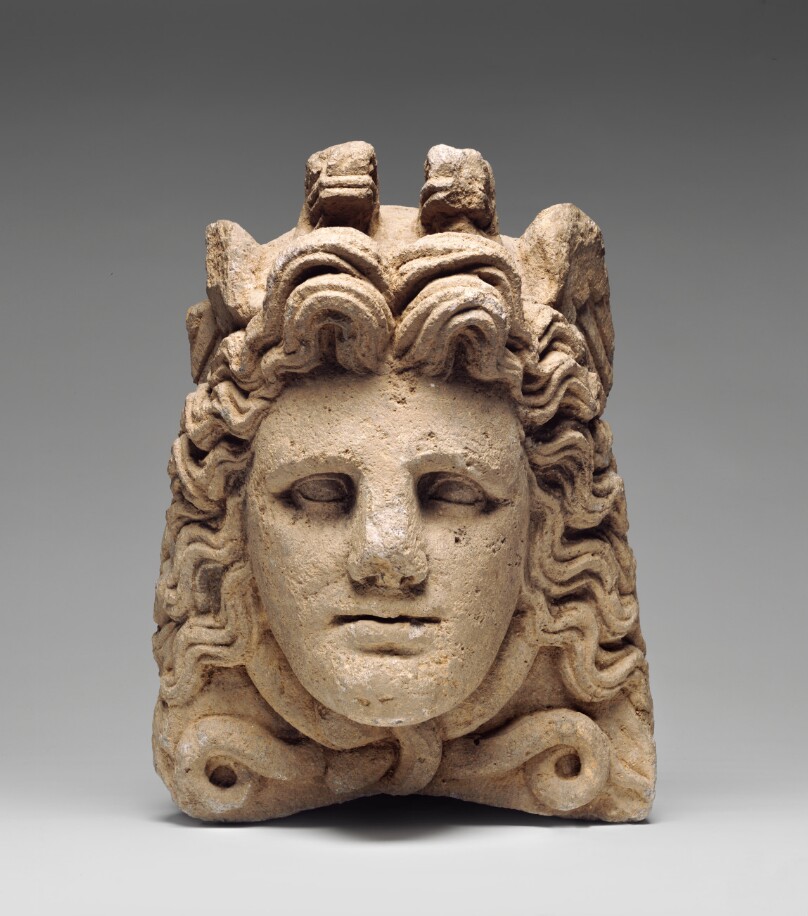
Akroterion with Medusa
Creator
UnknownAll works by this person →More on Getty ULAN- Date
- 300–275 B.C.
- Medium
- Tufa
- Culture
- Etruscan
- Department
- Architecture
- Institution
- Getty Museum
- Object ID
- ae82b7de-e7f8-4ace-a2f4-1cb6984de448
From the Getty Museum record
A sculpture that once crowned an architectural facade, this block is carved with the image of the Gorgon Medusa. On top of her head, a pair of wings flank two bearded serpent heads with their tails intertwined and knotted at her neck. Medusa’s snaky locks are shown as thick wavy curls extending out from both sides of her face, which is that of a beautiful woman with deeply carved eyes and full, slightly parted lips. Projecting from the lower end of the protome is a large rectangular tenon for insertion into the masonry structure, allowing the apotropaic image to project at a slight downward angle and gaze upon viewers below. With the exception of pitting on the surface of the face and an abrasion on the top of the nose, the protome is intact. The back of the head lacks curls, which would not have been visible, and is roughly worked; the end of the tenon is broken off. The function of this block with a protome carved fully in the round is evident from analogous surviving sculptures employed in both funeral chambers and civic buildings. Similar tufa gorgon heads decorated the façades of tomb monuments at Falerii Novi (the Tomba del Peccato) and Vulci (from Mandrione di Cavalupo). Other protomes, including Minerva, Jupiter, as well as male and female heads, decorated the Hellenistic gateways of Etruscan cities.
The authoritative record is held by Getty Museum. LinkedCulture surfaces this object and its connections; it does not alter institutional metadata.
Get printable QR codesHide QR codes
Open QR codes for this object page and the museum record. They stay collapsed until needed.
Related across collections
Semantically similar works from Getty Museum and other institutions.