Getty Museum
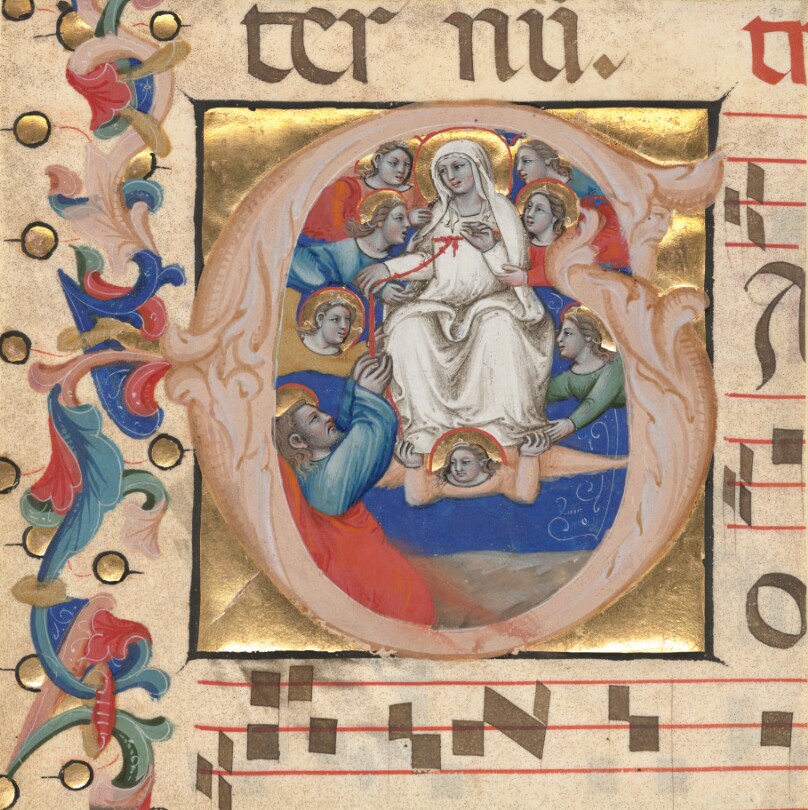
Six detached leaves from the Gradual of the Carthusian Monastery Santo Spirito near Lucca
Creator
Niccolò di Giacomo da BolognaItalian Illuminator · 1349–1403
All works by this person →Niccolò da Bologna was one of the most important and prolific manuscript illuminators of the fourteenth century in Bologna, a university town famous for its law faculty. He is known especially for his expressive figures and crowded, action-filled narrative scenes. The first signed works by Niccolò are all copies of Gratian's *Decretals,* one of the standard works of canon law. He and his workshop
More on Getty ULAN- Date
- Various, see extensions
- Medium
- Various, see extensions
- Culture
- Italian
- Department
- Manuscripts
- Institution
- Getty Museum
- Object ID
- c16e15bf-4923-4548-9e5f-2d19a6f7ad07
From the Getty Museum record
These six large historiated initials are from a group of twenty known cuttings originally from a choir book made for the Carthusian monastery of Santo Spirito, Lucca, commissioned by Niccolò di Lazzara, the archbishop of Lucca. Another cutting from the same manuscript is also in the Getty Collection ([Ms. 86](http://www.getty.edu/art/collection/objects/222802/niccolo-di-giacomo-da-bologna-cutting-from-a-choir-book-italian-about-1392-1402/)). The artist, Niccolò da Bologna, was the most prolific illuminator of the fourteenth century. He developed creative strategies for fitting figures and narratives within the curves or linear forms of initial letters in choral manuscripts. Three bearded men with identical features represent the Christian Trinity — God the Father, the Son, and the Holy Spirit — and the white robes of each create a visual exuberance of folds. The central figure holds open a book and makes a blessing gesture. In another, a group of five men gather around a soldier who has just beheaded a saint, whose bloody head and neck add a gruesome effect to the scene. Saint Mary Magdalene and the Virgin Mary, in separate initial "G’s," are assumed into heaven: the Magdalene is covered by her hair, which grew long during her meditation in the wilderness; the Holy Virgin gives her girdle to Saint Thomas, who according to the *Golden Legend* was in India at the time of Mary’s assumption (the girdle was one of the most celebrated relics in Tuscany at the time). The undulating form of an initial "S" divides a scene of the beheading of Saint Paul. Finally, the middle leg of an initial "M" separates the Apostles into two groups of six, several of whom hold the instruments of their death.
The authoritative record is held by Getty Museum. LinkedCulture surfaces this object and its connections; it does not alter institutional metadata.
Get printable QR codesHide QR codes
Open QR codes for this object page and the museum record. They stay collapsed until needed.
Related across collections
Semantically similar works from Getty Museum and other institutions.