Getty Museum
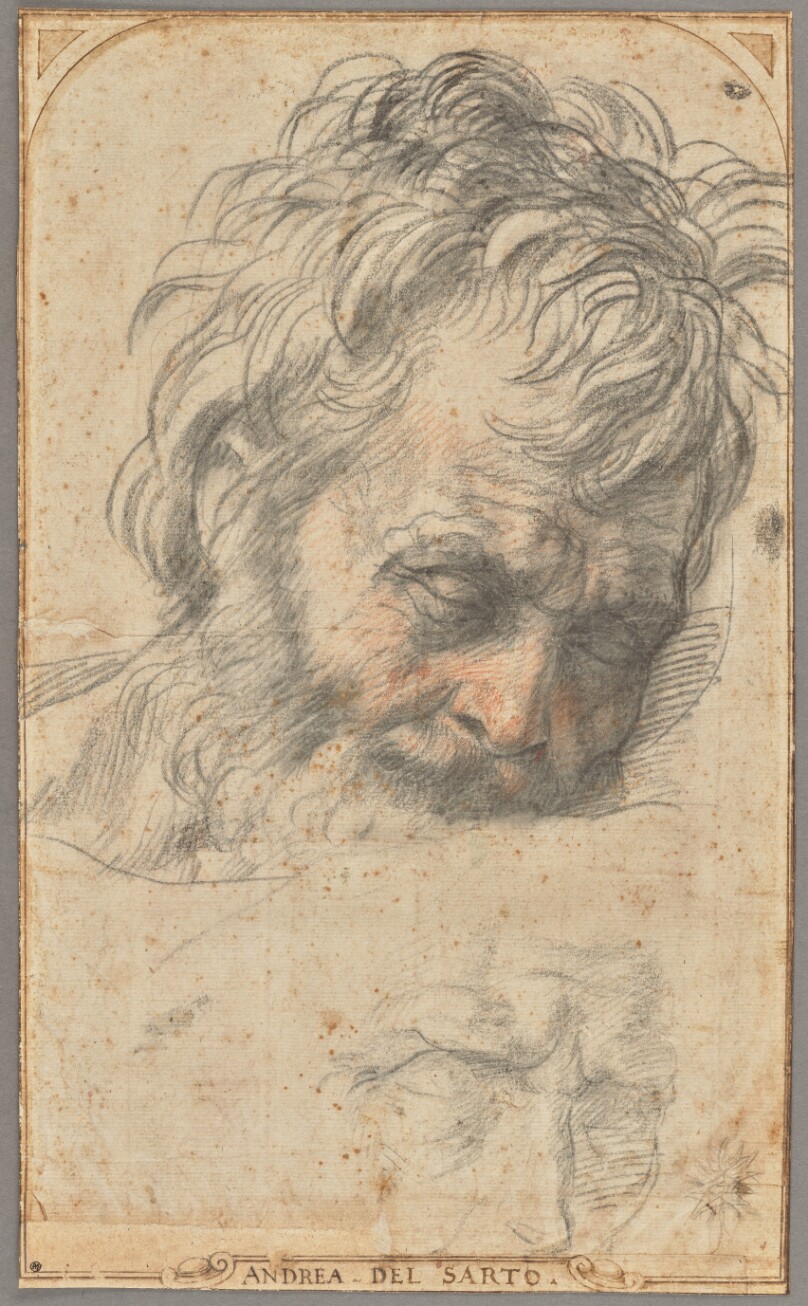
Study for the Head of Saint Joseph (recto); Two Studies of Legs (verso)
Creator
Andrea del SartoItalian Artist · 1486–1530
All works by this person →Andrea del Sarto, nicknamed Andrea "of the tailor" after his father's occupation, was one of Florence's leading artists in the early 1500s. Except for a visit to Rome around 1511, where his style gained greater monumentality, and a year-long stay in France in 1518, where he completed a few works at the invitation of François I, he spent most of his life in Florence. Patrons admired Andrea's fluent
More on Getty ULAN- Date
- about 1526–1527
- Medium
- Red and black chalks (recto); red chalk (verso)
- Culture
- Italian
- Department
- Drawings
- Institution
- Getty Museum
- Object ID
- c392263f-5754-47ba-ac27-dfa8662583bc
From the Getty Museum record
This large and impressive sheet was made by Andrea as a study for the sleeping Saint Joseph in the private devotional painting, the Bracci Holy Family, now in the Galleria Palatina, Florence and commonly known after the name of its patron, Zanobi di Giovambattista Bracci (1488–after 1531). In this deeply naturalistic study drawing, which is rendered on a similar scale to the figure in the painting, Andrea characteristically disregarded the lower part of the face, as it would be obscured when Joseph rested on his left arm. Andrea focused instead on the fall of light on the face and—most spectacularly—on the shadows cast within the vivid gray hair, rendered so realistically in the painting as a result of this drawing. Much of the black-chalk work is tied into effects of stumping, with the stump (a rolled piece of leather sharpened to a point) used to create patches of shadow that are then reworked with further strokes of chalk. Blank reserves of paper are skillfully left as highlights and firmer black-chalk lines create accented shadows. A brief subsidiary study lower on the page explores the possibility of raising Joseph’s head slightly and showing him awake. A further small-scale sketch in the bottom right corner studies the detail of a flower, although no flowers are present in the painting. On the verso of the sheet are two red-chalk sketches of legs, not securely connectable to any surviving work. The scale and power of this drawing is matched by its illustrious provenance. The first owner of the drawing, as evidenced by the characteristic inscribed mount on which it is laid, was none other than the artist and writer Giorgio Vasari (1511-1574), himself a pupil of Andrea del Sarto. Vasari is now often characterized as the “father of art history” for his published artist-biographies, and as an painter he was a key figure in sixteenth-century Medici Florence.
The authoritative record is held by Getty Museum. LinkedCulture surfaces this object and its connections; it does not alter institutional metadata.
Get printable QR codesHide QR codes
Open QR codes for this object page and the museum record. They stay collapsed until needed.
Related across collections
Semantically similar works from Getty Museum and other institutions.