Getty Museum
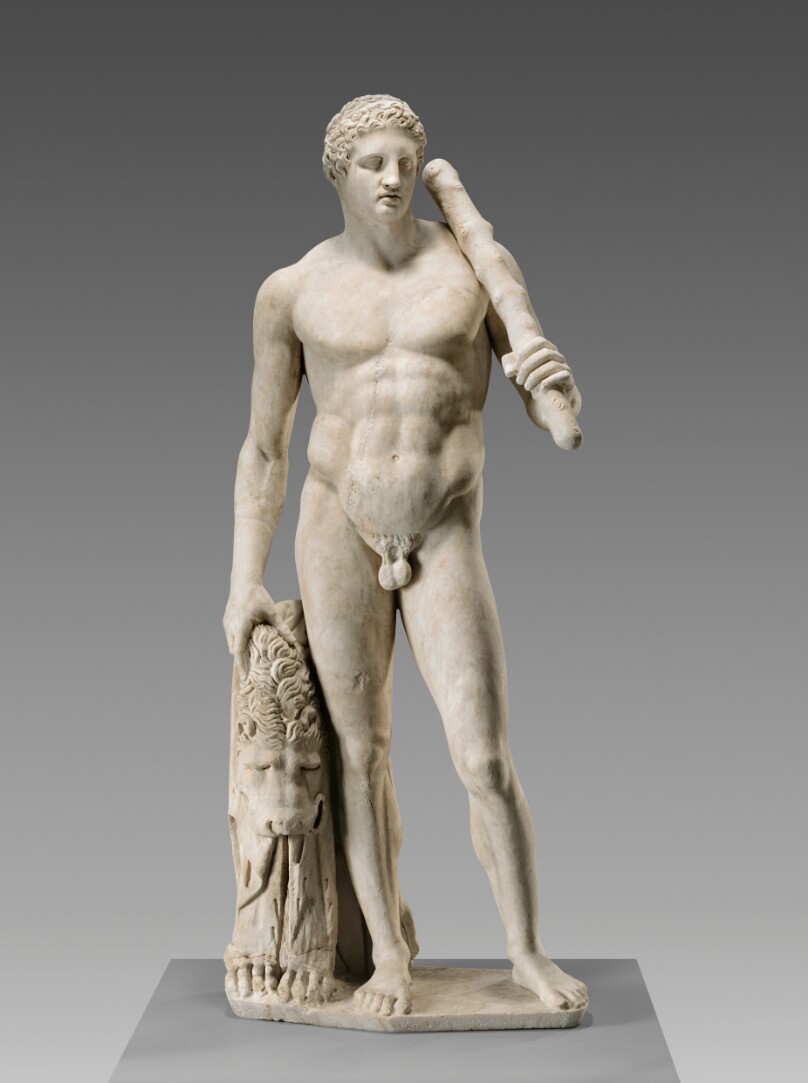
Statue of Hercules (Lansdowne Herakles)
Creator
UnknownAll works by this person →More on Getty ULAN- Date
- about A.D. 125
- Medium
- Marble
- Culture
- Roman
- Department
- Sculpture
- Institution
- Getty Museum
- Object ID
- d0522bc3-ed1c-4896-92a6-7600b26d1acc
From the Getty Museum record
The Greek hero Herakles carries a club over his left shoulder and holds a lionskin in his right hand. These objects help identify the figure, since Herakles was often depicted with a club and the skin of the Nemean Lion, which he killed as his first labor. As is typical for depictions of Greek heroes, the young Herakles is shown nude, since the Greeks considered male nudity to be the highest form of beauty. No other god or hero is as frequently depicted in Greek and Roman art as is Herakles. The Lansdowne Herakles very likely was inspired by a lost Greek statue, probably from the school of Polykleitos from the 300s B.C. Found in 1790 near the ruins of the villa of the Roman emperor Hadrian at Tivoli outside Rome, this statue was one of numerous copies of Greek sculpture commissioned by Hadrian, who loved Greek culture. One of J. Paul Getty's most prized acquisitions, the statue gets its name from Lord Lansdowne, who once owned the Herakles and displayed it in his home in London. Areas of restoration include the statue's lower left leg and parts of both arms.
The authoritative record is held by Getty Museum. LinkedCulture surfaces this object and its connections; it does not alter institutional metadata.
Get printable QR codesHide QR codes
Open QR codes for this object page and the museum record. They stay collapsed until needed.
Related across collections
Semantically similar works from Getty Museum and other institutions.