Getty Museum
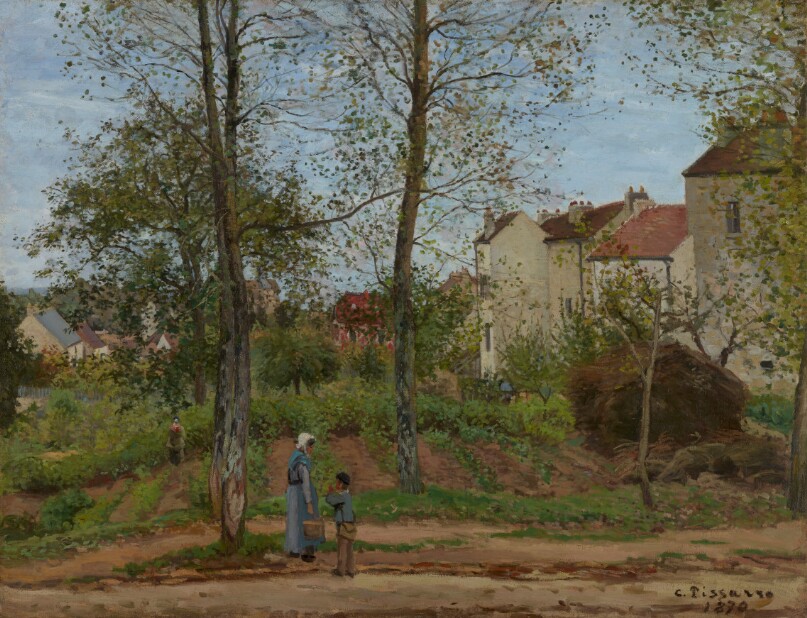
Landscape at Louveciennes (Autumn)
Creator
Camille PissarroFrench Artist · 1830–1903
All works by this person →Camille Pissarro was expected to work in his father's shop in the West Indies, not become an artist. After a long struggle, Pissarro arrived in Paris in 1855, where he studied with Camille Corot and met many of the future Impressionists. By 1866 he was painting entirely outdoors and living in dire poverty. On returning from London after the Franco-Prussian War, he discovered that German troops had
More on Getty ULAN- Date
- 1870
- Medium
- Oil on canvas
- Culture
- French
- Department
- Paintings
- Institution
- Getty Museum
- Object ID
- d3cf849f-486d-455e-bb55-3e38f3f47865
From the Getty Museum record
Within a few hundred yards of his home, Camille Pissarro painted a view of peasants working in a shady, wooded garden alongside a group of village houses. In the foreground, a woman carrying a bucket pauses to talk with a young boy carrying his school satchel over his shoulder. The gray sky and the trees losing their leaves indicate that it is autumn. Painting in the open air alongside Claude Monet and Pierre-Auguste Renoir, Pissarro followed a new practice of breaking up surfaces with loosely placed brushstrokes. This revolutionary technique, the cornerstone of Impressionism, helps to reveal how light and movement affect the perception of objects. Pissarro made the canvas a field of textures and movement; the character of the brushstroke varies according to the texture and form of the object it describes. For example, the haystack is painted with straw-shaped brushstrokes, the leaves are suggested by jagged daubs of paint, and the stucco walls are depicted with broad, smooth strokes.
The authoritative record is held by Getty Museum. LinkedCulture surfaces this object and its connections; it does not alter institutional metadata.
Get printable QR codesHide QR codes
Open QR codes for this object page and the museum record. They stay collapsed until needed.
Related across collections
Semantically similar works from Getty Museum and other institutions.