Getty Museum
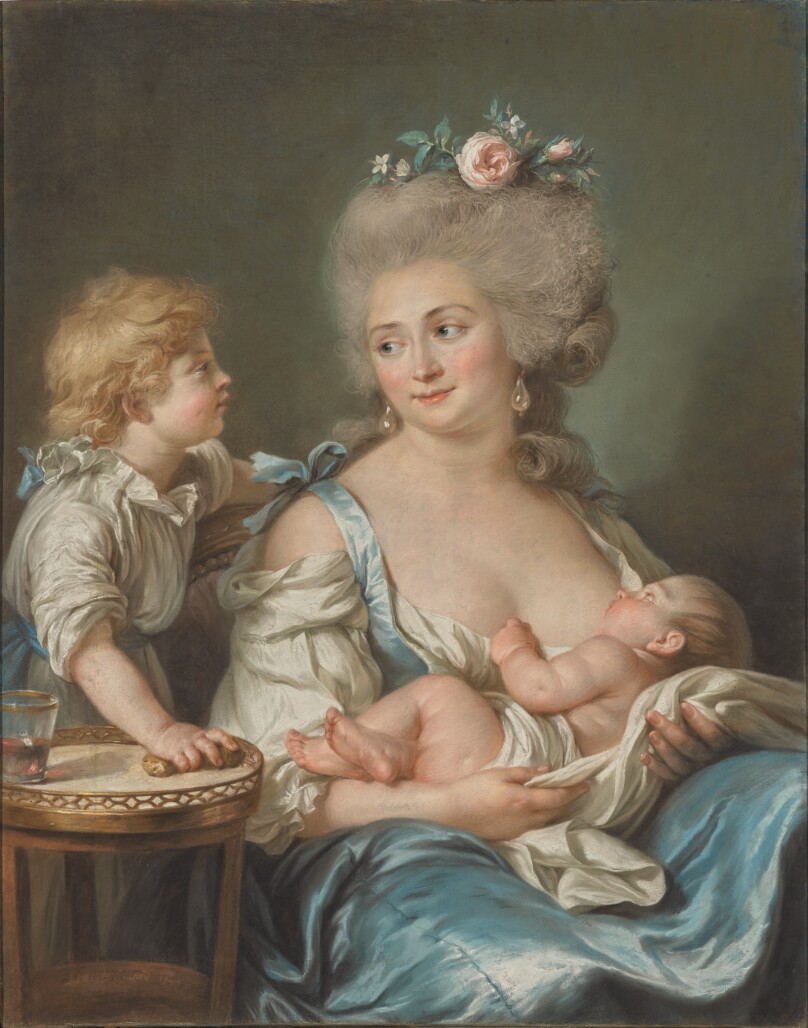
Portrait of Madame Charles Mitoire with Her Children
Creator
Adélaïde Labille-GuiardFrench Artist · 1749–1803
All works by this person →In forging a successful career as a portraitist, Adélaïde Labille-Guiard had to overcome an unwelcoming male-dominated art world. Labille-Guiard was often described as a bitter rival of the best-known woman painter of the time, Elisabeth Louise Vigée-Le Brun, but this rivalry was in fact the invention of male artists and critics threatened by their female competitors. After Labille-Guiard's Salon
More on Getty ULAN- Date
- 1783
- Medium
- Pastel, on three sheets of blue paper, mounted on canvas
- Culture
- French
- Department
- Drawings
- Institution
- Getty Museum
- Object ID
- d41ee101-ddba-4021-9dac-d7e8584b2acd
From the Getty Museum record
In a gown of pale blue satin, wearing pearls in her ears and a powdered coiffure piled with roses and orange blossom, Madame Charles Mitoire (née Christine Geneviève Bron, 1760-1842) offers an affectionate smile to her two sons: Alexandre-Laurent (1780-1816), a boy of three with soft curls and a dimpled smile; and Charles-Benoît (1782-1832), a babe in arms, seminude. Applying pastels both wet, with a brush, and dry, with a stick, Labille-Guiard imparted distinct textures to all the different softnesses here depicted: silk and muslin, petals and curls, a mother’s bosom, a baby’s bottom. For all its pearls and powder, this is no ordinary portrait of an eighteenth-century lady, for Madame Mitoire here bears a breast to nurse Charles-Benoît. Though its composition echoes traditional representations of the Virgin and Child with Saint John the Baptist, this portrait also quite radically signals the modernity of its subject and her approach to motherhood. Published in 1762, Jean-Jacques Rousseau’s celebrated Enlightenment treatise on education and child-rearing, Émile, implored women of all classes to cultivate more intimate bonds with their children and, above all, to breast-feed them personally, rather than retaining the services of a wet nurse, as most wealthy families then did. A vogue for breast-feeding swept Europe, and genteel women retreated from public life, into the domestic sphere to fulfill what Rousseau called “their first duty." Depicting a nursing mother, the Portrait of Madame Charles Mitoire may also allude to Rousseau’s recommendations in its presentation of the infant, unencumbered by swaddling clothes (of which Rousseau strongly disapproved) and perhaps also in its inclusion of a glass of wine on the table at left (Rousseau’s tract draws a contrast between milk, “our first nourishment,” and wine, an acquired taste).
The authoritative record is held by Getty Museum. LinkedCulture surfaces this object and its connections; it does not alter institutional metadata.
Get printable QR codesHide QR codes
Open QR codes for this object page and the museum record. They stay collapsed until needed.
Related across collections
Semantically similar works from Getty Museum and other institutions.