Getty Museum
Madonna and Child
Creator
Master of St. CeciliaItalian Artist · 1290–1320
All works by this person →The history of painting in Florence has been distinguished by many famous names, but the identity of one influential artist remains a mystery: the Master of St. Cecilia. Because his work contains poses and Greek inscriptions derived from Roman paintings and mosaics, historians suggest that the Master of St. Cecilia may originally have come from Rome. He was active in Florence in the late 1200s and
More on Getty ULAN- Date
- about 1290–1295
- Medium
- Tempera and gold leaf on panel
- Culture
- Italian
- Department
- Paintings
- Institution
- Getty Museum
- Object ID
- d47f77ba-ee72-4e8a-bc5b-b1f0a98dca78
From the Getty Museum record
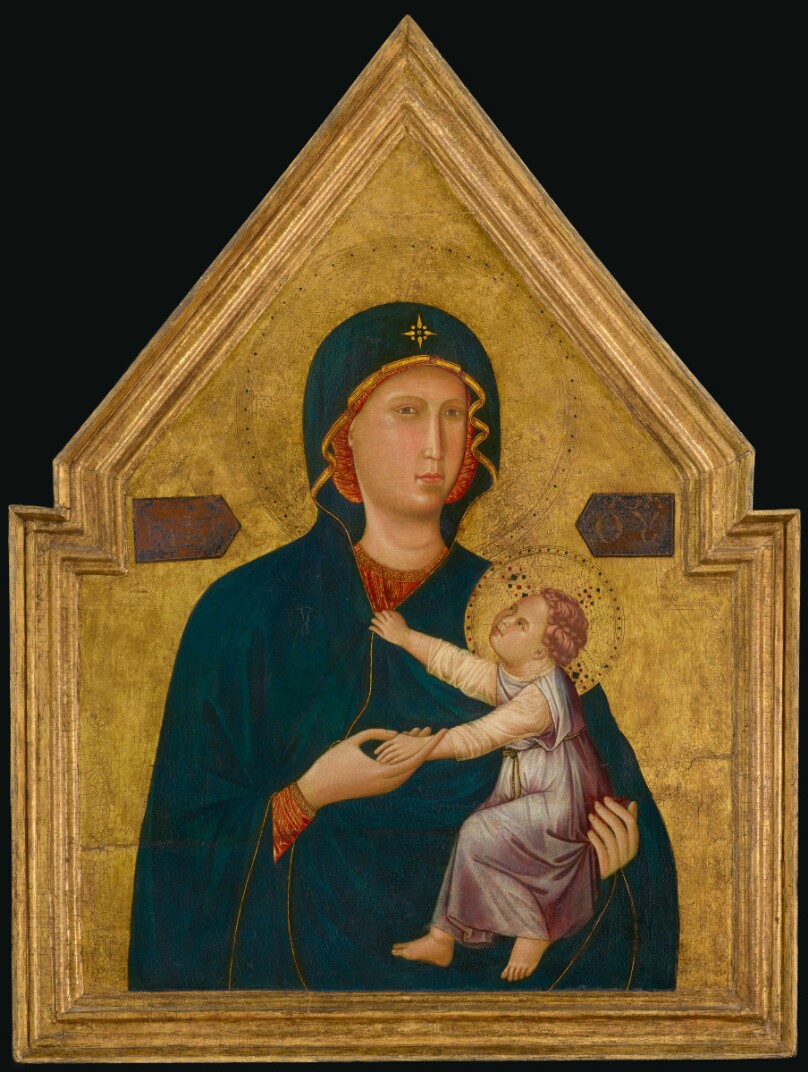
The Virgin Mary, hieratic and still, looks out toward the viewer while gently supporting Christ with her left arm. The smiling infant gazes lovingly toward her and playfully stretches out his arm, grabbing the edge of her gold-trimmed, blue cloak. The star over the Madonna's forehead refers to her title "Star of the Sea," the meaning of the Jewish form of her name, Miriam. The Virgin's rigid and formal pose reflects the icon tradition of the Byzantine Empire. The painting's format and the ornamental scroll on either side of the Madonna also find close parallels in Byzantine icons. But unlike Byzantine work, the Master of Saint Cecilia emphasizes the intimate connection between the Madonna and Child, embodied at the Virgin's breast where her right hand gently cradles Christ's tiny left hand. This humanizing tendency would become increasingly prominent in Western Europe and a hallmark of Renaissance imagery of the Madonna and Child.
The authoritative record is held by Getty Museum. LinkedCulture surfaces this object and its connections; it does not alter institutional metadata.
Get printable QR codesHide QR codes
Open QR codes for this object page and the museum record. They stay collapsed until needed.
Related across collections
Semantically similar works from Getty Museum and other institutions.