Getty Museum
Leaf from a Bible
Creator
UnknownAll works by this person →More on Getty ULAN- Date
- about 1260–1270
- Medium
- Tempera colors, gold leaf, and red ink
- Culture
- Franco-Flemish
- Department
- Manuscripts
- Institution
- Getty Museum
- Object ID
- da8db6a9-bbbf-4312-ab11-8f1fd38b82ed
From the Getty Museum record
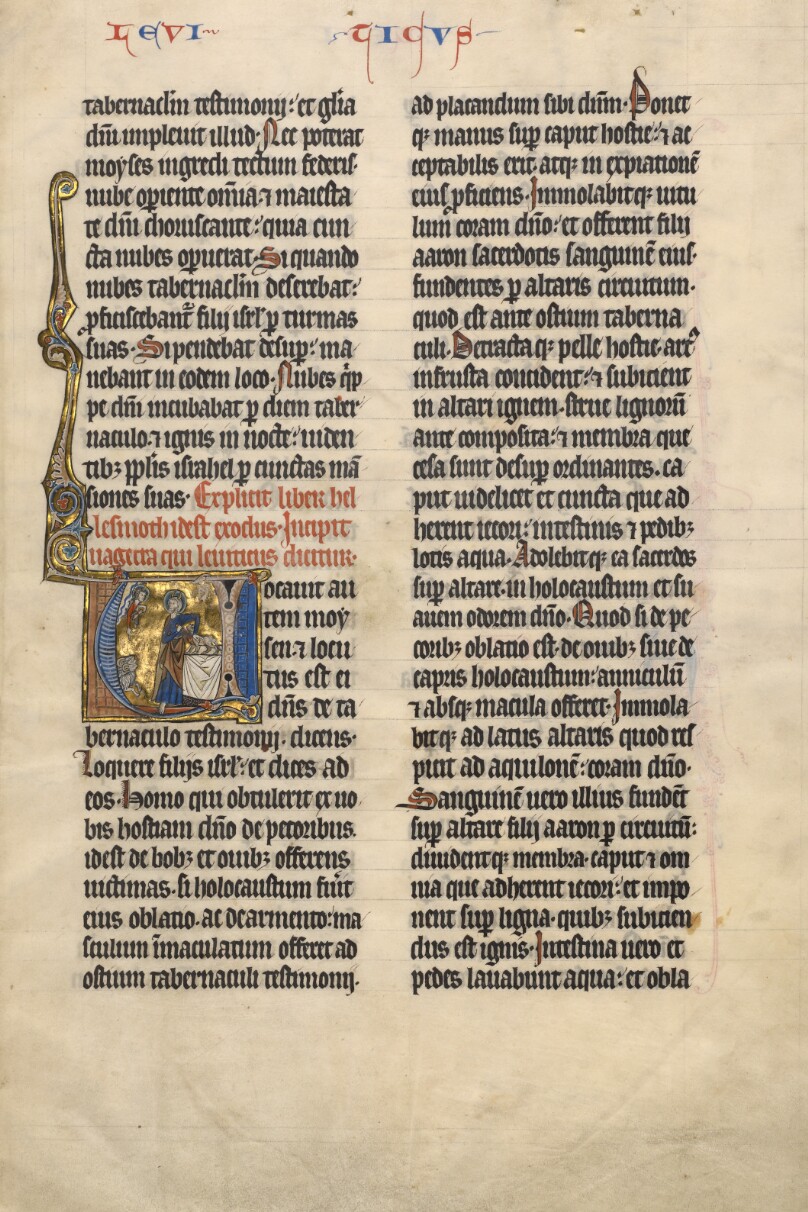
As scriptoria in thirteenth-century Paris were starting to produce small, portable bibles for university students, workshops in northeast France continued to manufacture very large bibles for the communal use of monks and nuns in monasteries. This sheet, with a large initial containing an illumination of the Old Testament Prophet Moses sacrificing a Lamb, comes from one such grand Christian Bible. Per the title in red and blue letters at the very top of the leaf, the text comes from the Old Testament Book of Leviticus. This book contains God’s speeches to Moses, which Moses in turn communicates to the Israelites. The opening concerns God’s rules and regulations concerning the practices of sacrifice and ritual, including the blood sacrifice of cattle and sheep to God. In this historiated initial (an enlarged initial that includes a narrative illustration) that marks Leviticus’ opening, the illuminator depicts Moses sacrificing a lamb atop an altar with white cloth. The prophet looks up towards God, who emerges from a cloud and points down towards three rams. Noticeably, Moses has a pair of horns. This is common in thirteenth-century manuscript illumination. Originating from an error in St. Jerome’s translation of the Hebrew Bible, the horned Moses was a standard antisemitic visual trope of the Middle Ages, as Christians often imagined Jews as satanic in nature. The image of Moses sacrificing a lamb is also a typological reference to the Book of Revelation. In this book from the New Testament, the imagery of the Lamb of God appears several times, with the Lamb serving as a metaphor for Jesus Christ, sacrificed for the atonement of the sins of humankind.
The authoritative record is held by Getty Museum. LinkedCulture surfaces this object and its connections; it does not alter institutional metadata.
Get printable QR codesHide QR codes
Open QR codes for this object page and the museum record. They stay collapsed until needed.
Related across collections
Semantically similar works from Getty Museum and other institutions.