Getty Museum
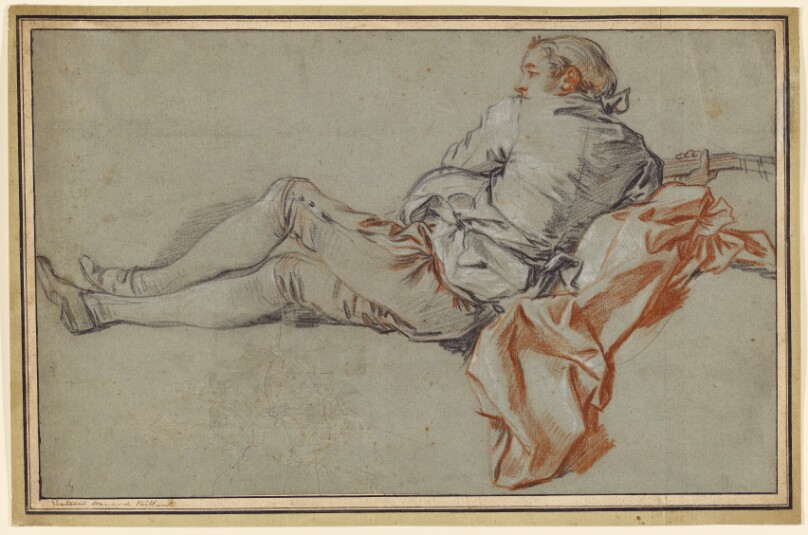
Reclining Male Figure
Creator
François BoucherFrench Artist · 1703–1770
All works by this person →For François Boucher, "art" meant "artifice." He could paint straightforward genre scenes and portraits when appropriate, but the times called for enchantment and frolic, with just the right touch of titillation. Boucher's paintings and drawings celebrated a silvery, shimmering world of perfumes and powders, inspiring copies of his designs in media ranging from textiles and marquetry to porcelain.
More on Getty ULAN- Date
- 1736
- Medium
- Black, red, and white chalks, on blue paper
- Culture
- French
- Department
- Drawings
- Institution
- Getty Museum
- Object ID
- dddca1cc-86a8-4c92-9813-0390fc62446e
From the Getty Museum record
A young man lies outstretched with his legs crossed, reclining on a bunched piece of fabric and strumming a lute or another stringed instrument. With his back to the viewer and his face partially hidden, the man's twisted pose rather than his identity becomes the focus of the drawing. The gathers of fabric on which he leans, the wrinkled folds of his coat, and the outstretched length of his legs all create interest and draw the viewer's eyes around the figure and into the composition. François Boucher used a technique known as *aux trois crayons*, in red, black, and white chalks, which he and his contemporaries made popular in France in the 1700s. As a middle tone, he adopted the blue paper favored by Venetian artists. A favorite painter at the French court, Boucher designed tapestries for the royal factories, Beauvais and Gobelins. He made this drawing, one of very few that survive, for his first suite of tapestries, the *Fêtes italiennes*.
The authoritative record is held by Getty Museum. LinkedCulture surfaces this object and its connections; it does not alter institutional metadata.
Get printable QR codesHide QR codes
Open QR codes for this object page and the museum record. They stay collapsed until needed.
Related across collections
Semantically similar works from Getty Museum and other institutions.