Getty Museum
The Borghese-Windsor Cabinet
Creator
UnknownAll works by this person →More on Getty ULAN- Date
- cabinet about 1620; stand before 1821
- Medium
- Cabinet: Fir walnut and chestnut veneered with various tropical hard woods, set with lapis lazuli, jasper, agate, amethyst, and other hard stones ('pietre dure' in Italian); gilt bronze; silver and silver gilt; Stand: Beech, mahogany and oak ebonized and veneered with ebony; ebony columns; lacquered brass; mirrored glass
- Culture
- Italian (cabinet); French (stand)
- Department
- Decorative Arts
- Institution
- Getty Museum
- Object ID
- eef7f04b-648b-42ed-89c3-0448e8897498
From the Getty Museum record
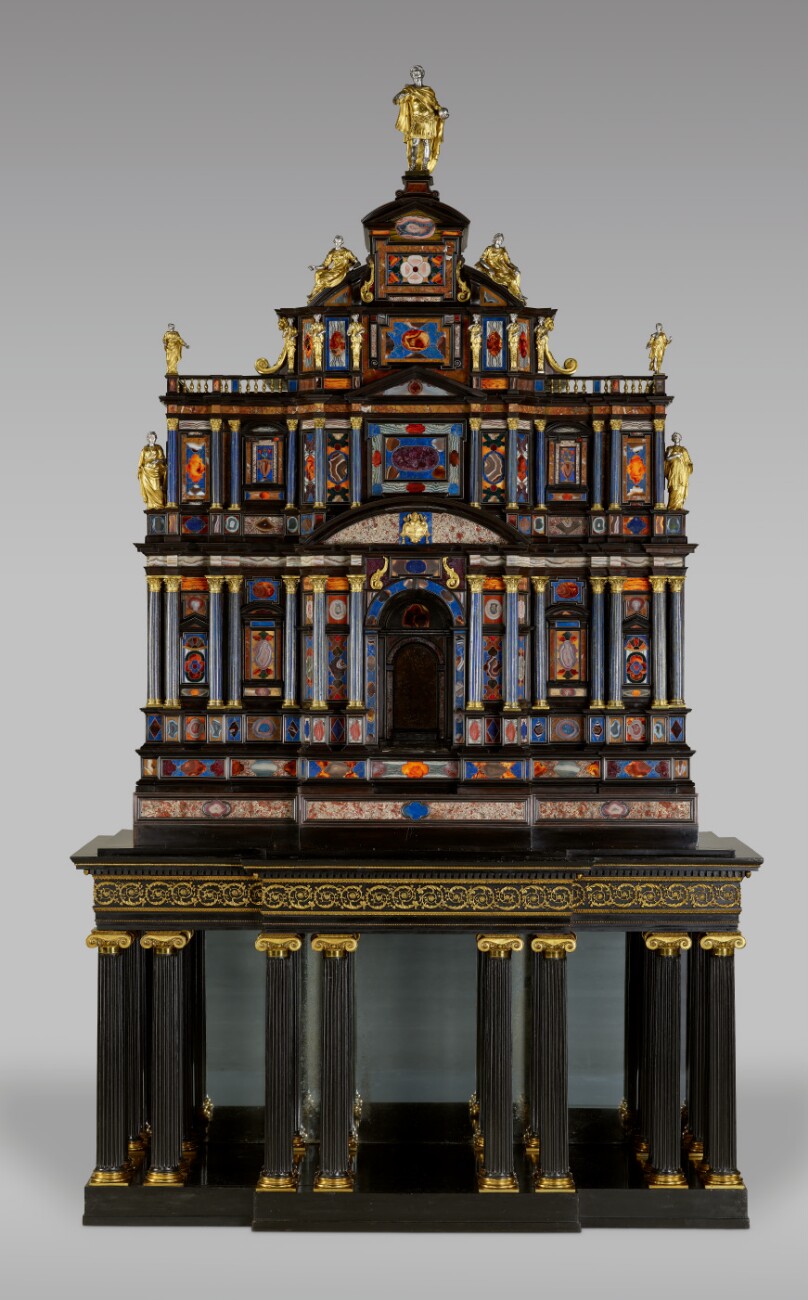
This piece of furniture is a specific kind of display cabinet called 'stipo' or 'studiolo' in Italian. Made in Rome, it belonged to Pope Paul V Borghese (ruled 1605-21), whose coat of arms (the eagle and the dragon) is featured above the central niche. Already in an English private collection by 1821 when it was offered for sale with its stand in London, the cabinet was then acquired by King George IV (ruled 1820-30). It remained in the British Royal Collection until 1959, when it was sold with the collection of Queen Mary. Such showpiece cabinets–brilliantly colored in their use of precious materials, but also intriguing with their multiple drawers–were the most prestigious display furniture in Europe from the late sixteenth to early eighteenth century. They were used to store such treasures as medals, gems, and small bronzes or ivories, as well as private documents. Designed to resemble the façade of a Baroque church, the Borghese-Windsor Cabinet is exceptional in its large size and sumptuous decoration. Expensive and difficult to cut and polish, the numerous hard stones ('pietre dure' in Italian) covering the front in elaborate geometrical and chromatic patterns demonstrate the rarity of this piece. The statuettes, with draperies in gilt bronze and with heads, hands, and legs in silver, add to its luxuriousness. The stand on which the cabinet sits was created for it in the 1820s, and is an impressive architectural piece of furniture in its own right. Its shape elegantly follows that of the cabinet, the front breaking forward in the center to conform to its footprint. With a mirrored backboard, it is composed of a sober podium on top of which twenty-four fluted Ionic columns in solid ebony support the upper table adorned with a frieze of lacquered brass foliated scrolls.
The authoritative record is held by Getty Museum. LinkedCulture surfaces this object and its connections; it does not alter institutional metadata.
Get printable QR codesHide QR codes
Open QR codes for this object page and the museum record. They stay collapsed until needed.
Related across collections
Semantically similar works from Getty Museum and other institutions.