Getty Museum
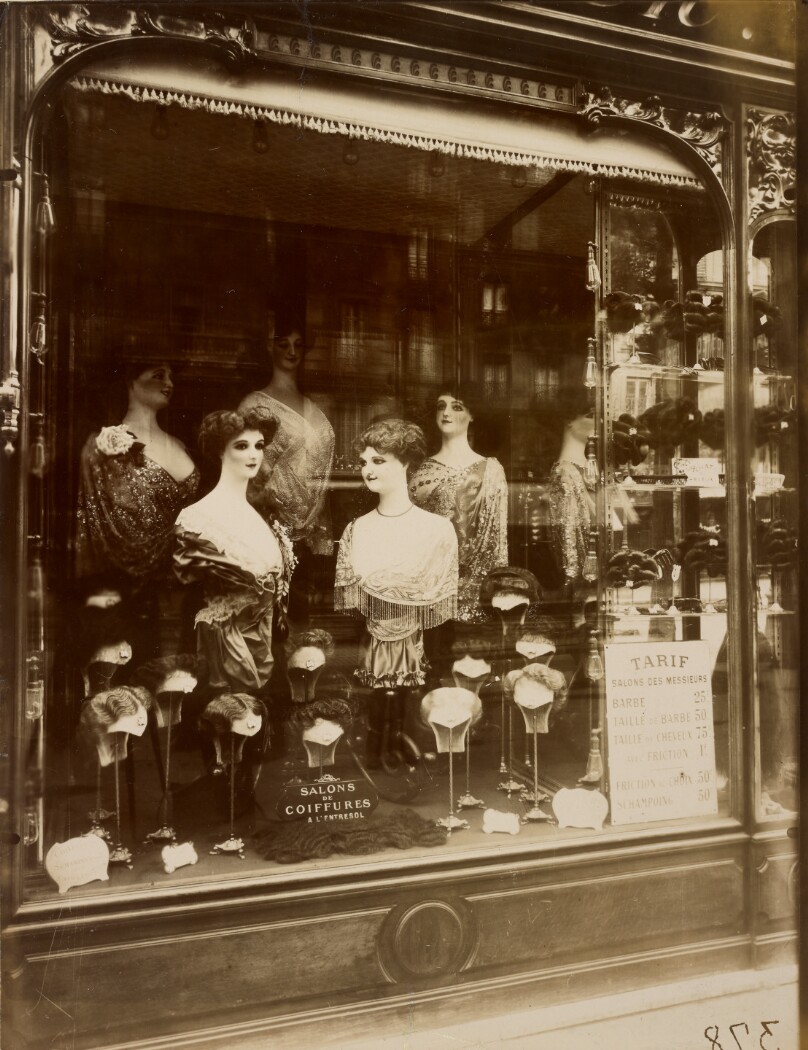
Boulevard de Strasbourg
Creator
Eugène AtgetFrench Photographer · 1857–1927
All works by this person →Eugène Atget never called himself a photographer; instead he preferred "author-producer." A private, almost reclusive man, Atget first tried his hand at painting and acting, then began to photograph *vieux Paris* (Old Paris) in 1898. He photographed in part to create "documents," as he called his photographs, of architecture and urban views, but he supported himself by selling these photographs to
More on Getty ULAN- Date
- 1912
- Medium
- Gelatin silver chloride printing-out paper print
- Culture
- French
- Department
- Photographs
- Institution
- Getty Museum
- Object ID
- f0105e73-ebc9-494d-b596-9fd449a70729
From the Getty Museum record
> Framed in Art Nouveau tendrils, this establishment proffers a wide variety of services to do with hair. Although the disembodied mannequins are all female, the sign at right advertises that in rooms reserved for men, shaving, beard trimming, haircutting, and shampooing, wet or dry, are available. For women, hairdressing could be obtained as well as wigs, both full and partial. To make these hairpieces more alluring to potential customers, the busts in the window are elaborately draped with shimmering or diaphanous material in order to create the plunging necklines fashionable during the period and are set on little pedestals with satin ruffled covers. At the front of the window, displayed on headless foreheads, are rows of wiglets, to be had either waved or fringed in a variety of colors. The tasseled shade at the top of the window, to be let down after hours, resembles the curtain called a teaser at the top of a proscenium arch and reinforces the theatricality of the kohl-rimmed eyes of the painted ladies. Apparently a perennially popular site to cut, style, or imitate hair, the somewhat seedy present-day boulevard de Strasbourg contains numerous hairdressers' shops, nearly all of which bill themselves as unisex salons. > > Although there are dim reflections in the window glass, it was only later in Eugène Atget's career, after World War I, that he would more consciously manipulate reflected light for artistic effect (see, for example, [84.XM.1034.15](https://www.getty.edu/art/collection/objects/55729/eugene-atget-storefront-avenue-des-gobelins-french-1925/) and [90.XM.64.21](https://www.getty.edu/art/collection/objects/63456/eugene-atget-salon-de-coiffure-hairdresser's-shop-french-1926/)). > > Originally published in *Eugène Atget*, In Focus: Photographs from the J. Paul Getty Museum by Gordon Baldwin (Los Angeles: J. Paul Getty Museum, 2000), 56. ©2000, J. Paul Getty Trust.
The authoritative record is held by Getty Museum. LinkedCulture surfaces this object and its connections; it does not alter institutional metadata.
Get printable QR codesHide QR codes
Open QR codes for this object page and the museum record. They stay collapsed until needed.
Related across collections
Semantically similar works from Getty Museum and other institutions.