Getty Museum
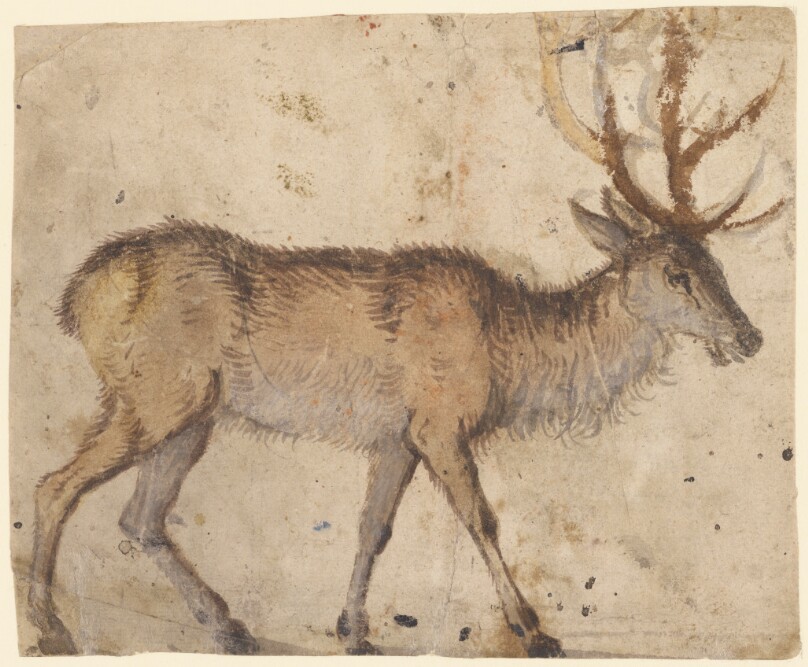
Study of a Stag (recto); Study of Goats (verso)
Creator
Lucas Cranach the ElderGerman Artist · 1472–1553
All works by this person →Lucas Cranach the Elder took his surname from his birthplace, Kronach, where he probably trained with his painter father. Around 1501 he went to Vienna, where he focused on drawing ruins and windswept trees. In 1505 he became court painter to Frederick the Wise of Saxony in Wittenberg, a position he maintained for life under various electors. At court, Cranach specialized in portraits. Bold design
More on Getty ULAN- Date
- about 1520–1530
- Medium
- Brush with brown and red brown wash, heightened with white gouache (recto); brush with black, gray, and green wash, black chalk (verso)
- Culture
- German
- Department
- Drawings
- Institution
- Getty Museum
- Object ID
- f1ebbc5f-8f0b-4a0e-bde0-98b4fd4b7843
From the Getty Museum record
Lucas Cranach the Elder often painted carefully described animals, one of his particular specialties and a typical manifestation of Renaissance interest in nature. He frequently depicted stags, both as victims of the hunt and as onlookers. Here Cranach began with a sketch in black chalk, which he then went over rapidly with a brush and ink wash, using broad strokes to create the long, furry winter coat. He then freely applied varied washes to the legs and antlers. On the verso, a quickly brushed yet well-formed three-dimensional goat grazes energetically. The head of another goat is cut off by the edge of the paper, and a light black chalk sketch of a third peers outward above the neck of the main animal. All three animals stare saucily at the viewer with engagingly direct gazes.
The authoritative record is held by Getty Museum. LinkedCulture surfaces this object and its connections; it does not alter institutional metadata.
Get printable QR codesHide QR codes
Open QR codes for this object page and the museum record. They stay collapsed until needed.
Related across collections
Semantically similar works from Getty Museum and other institutions.