Getty Museum
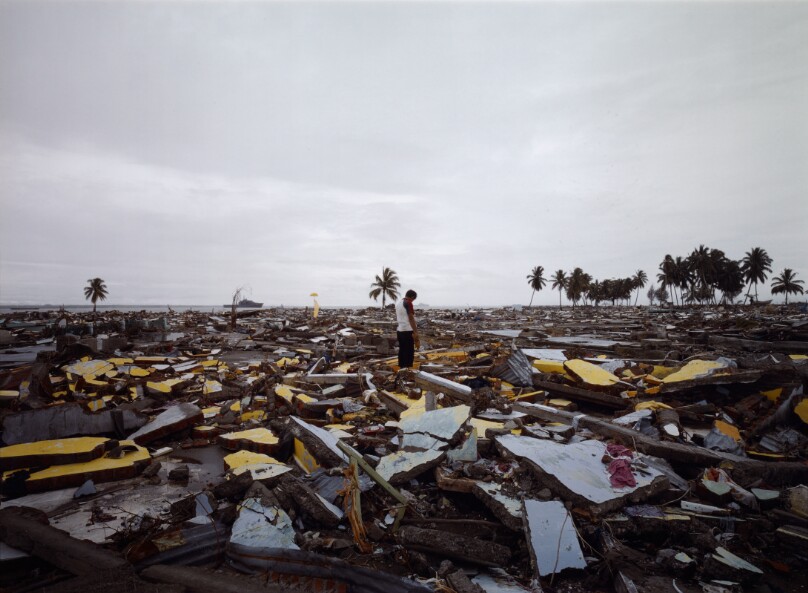
Aftermath in Meulaboh
Creator
Luc DelahayeFrench Photographer · 1962–present
All works by this person →> There is something rather beautiful about the practice of photography: it allows the self to be reunited with the world, to achieve a unity with the real. > > --Luc Delahaye Luc Delahaye trains his camera on unexpected or unfamiliar aspects of current events from Iraq to Vienna to Chad. Unlike the ceaseless, sensationalist flow of mass media images, Delahaye's photographs of war, natural catastr
More on Getty ULAN- Date
- negative January 9, 2005; print February 2006
- Medium
- Chromogenic print
- Culture
- French
- Department
- Photographs
- Institution
- Getty Museum
- Object ID
- f20d05c4-6b06-4cf9-be6f-2b92c367720d
From the Getty Museum record
An endless expanse of debris and devastation convey the unparalleled power of the tsunami that hit the Indonesian city of Meulaboh. In an instant, homes have been reduced to rubble; incongruously colorful shards are littered with clothing, personal effects, and debris. In the distance, the few remaining palm trees underscore the fact that everything else in the scene has been flattened, razed, destroyed. At the photograph's center, a single man embodies the tsunami's human toll. This despondent figure looks over the remains of his home, searching for anything salvageable and, most of all, remembering lives lost. French photographer Luc Delahaye took this photograph in early January 2005--about ten days after the Indian Ocean earthquake that triggered a series of devastating tsunamis across Southeast Asia. Delahaye had first arrived in the provincial capital, Banda Aceh; but finding the international press concentrated there, he traveled southeast to Meulaboh. In this photograph, he focuses his camera on a part of the city closest to the seashore and worst hit by the tsunami. From a distant, frontal point of view, his camera records the scene with detail and accuracy and includes an unusual peripheral vision that reveals destruction as far as the eye can see. Beginning in 2001 with the Afghanistan war, Delahaye initiated a series of large-scale photographs featuring significant events of recent history. On one hand, these detailed, frontal works relate to the tradition of documentary photography. On the other, their size and narrative power evoke nineteenth-century European painting. Compositionally, *Aftermath in Meulaboh* recalls Caspar David Friedrich's early 1800s painting *Arctic Shipwreck* --which also depicts nature's destructive power.
The authoritative record is held by Getty Museum. LinkedCulture surfaces this object and its connections; it does not alter institutional metadata.
Get printable QR codesHide QR codes
Open QR codes for this object page and the museum record. They stay collapsed until needed.
Related across collections
Semantically similar works from Getty Museum and other institutions.