Getty Museum
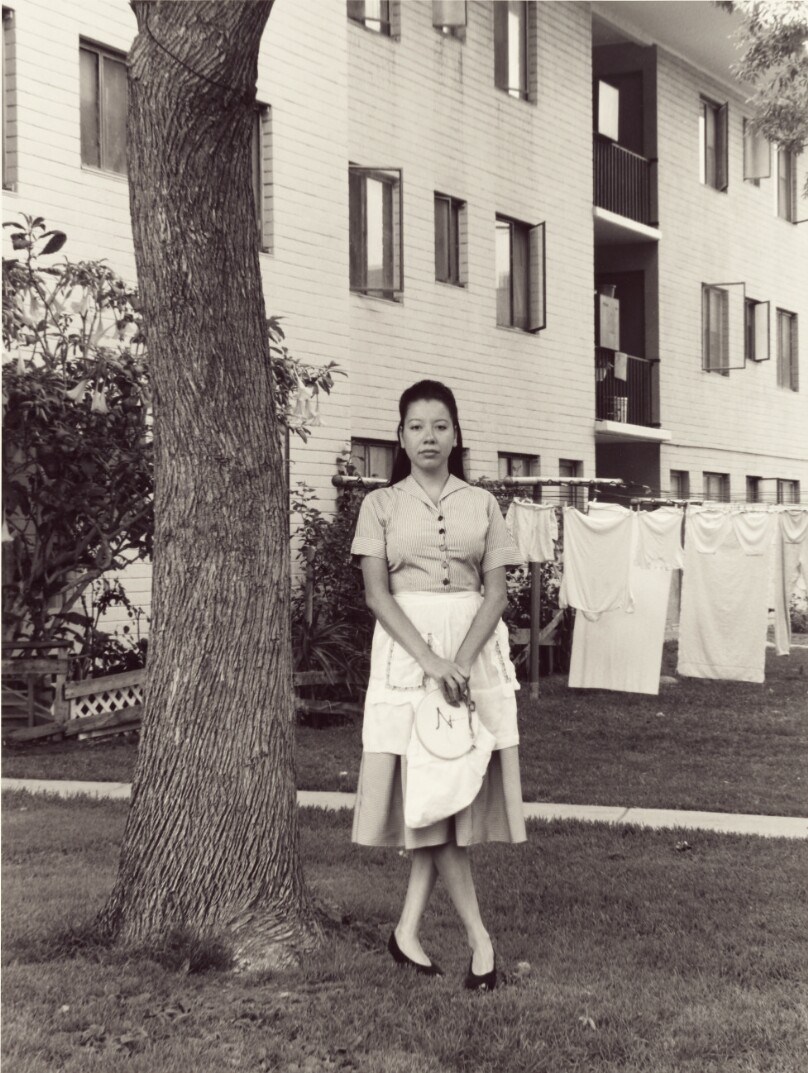
1945, Aliso Village, Boyle Heights, California
Creator
Christina FernandezAmerican Photographer · 1965–present
All works by this person →More on Getty ULAN- Date
- 1996
- Medium
- Gelatin silver print
- Culture
- American
- Department
- Photographs
- Institution
- Getty Museum
- Object ID
- f77f6c22-542c-40ab-9ac9-7b9b25943652
From the Getty Museum record
*María’s Great Expedition* interweaves familial and national histories to create a suite of prints that are both personal and political. Christina Fernandez inserts herself into the title role, and through six photographs of staged scenes and a map (see [2014.37.7](https://www.getty.edu/art/collection/objects/267457/christina-fernandez-composite-map-american-1996/)) reimagines the story of her great-grandmother, María Gonzales, who migrated from Mexico to Southern California as a single mother (see [2014.37.1-.7](https://www.getty.edu/art/collection/search/?view=grid&query=YToxOntzOjU6InF1ZXJ5IjtzOjc6IjIwMTQuMzciO30%3D)). Drawn from interviews the artist conducted with family members, as well as historical accounts of life in both America and Mexico at the turn of the twentieth-century, these scenes reference stories about the formidable challenges of starting anew in an unfamiliar place. Fernandez has written, > María was already a legend in my family. She was somebody I was told about, and, being the oldest granddaughter, I was always all ears in family conversations. (I think I know more than the adults ever wanted me to know!) But because of this she was sort of in my head, somebody to be proud of, someone who had merit—and the reason we were here in “America.” Her hard work shaped the family work ethic and the desire to achieve both academically and within our chosen careers. In the process of researching and then incorporating what she had learned into her piece, Fernandez realized how difficult things had been for her grandmother and others like her—“[t]he racism, sexism, and elitism she endured, her desire to leave her country of origin and its religion behind, and branch out into the vast unknown (at least, unknown to her) of the Southwest.” Through Fernandez’ choice of costumes and use of a variety of photographic techniques (gelatin silver prints and a chromogenic print), she signals the passage of time. She also provides a map and intimate textual narratives in English and Spanish that offer insight into the circumstances of María’s journey and undermine stereotypes about immigrants. Fernandez has reflected, > I wanted the presentation to be like a natural history museum display, where there is an abundance of information, texts, maps, charts, etc. I was putting forward María’s migration story as that of an explorer . . . I recontextualized her story by positing migration as an exploration or expedition . . . Fernandez’s paired narrative is displayed above alongside the photograph. Adapted from Arpad Kovacs, wall text from the exhibition *Encore: Reenactment in Contemporary Photography*, J. Paul Getty Museum, March 12-June 9, 2019; with quotes excerpted from Christina Fernandez and Lucy Gallum, “New to MOMA: Christina Fernandez’s *María’s Great Expedition*", *MOMA Magazine*, May 20, 2019.
The authoritative record is held by Getty Museum. LinkedCulture surfaces this object and its connections; it does not alter institutional metadata.
Get printable QR codesHide QR codes
Open QR codes for this object page and the museum record. They stay collapsed until needed.
Related across collections
Semantically similar works from Getty Museum and other institutions.