Getty Museum
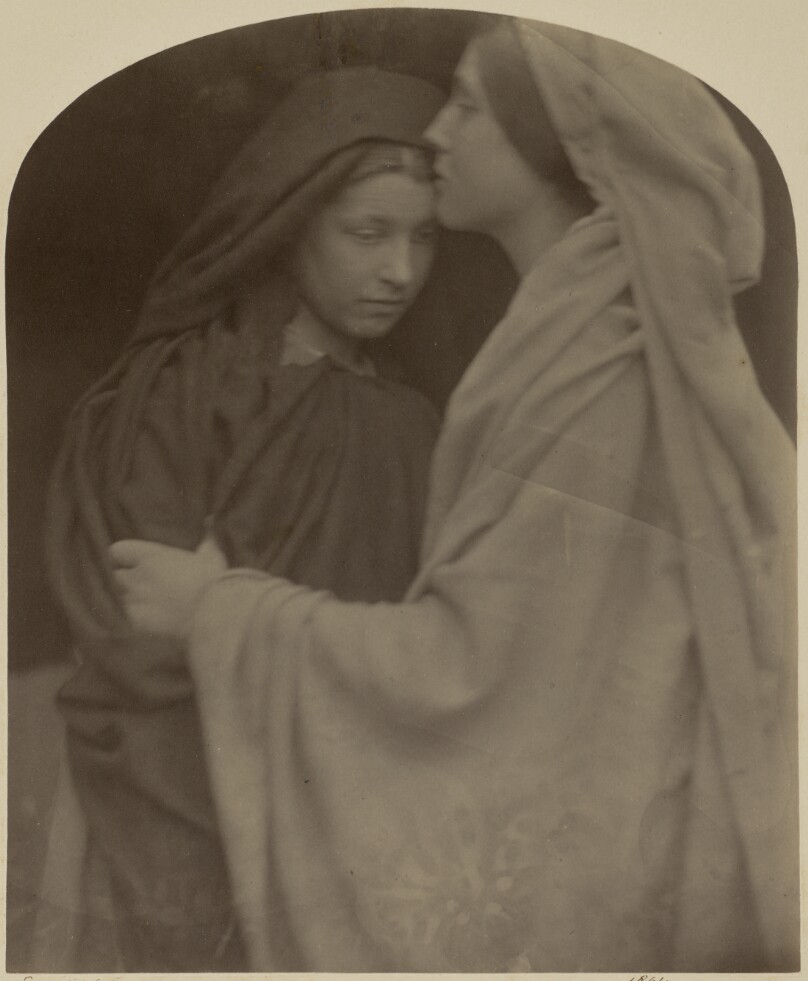
The Salutation
Creator
Julia Margaret CameronBritish Photographer · 1815–1879
All works by this person →After receiving a camera as a gift, Julia Margaret Cameron began her career in photography at the age of forty-eight. She produced the majority of her work from her home at Freshwater on the Isle of Wight. By the coercive force of her eccentric personality, she enlisted everyone around her as models, from family members to domestic servants and local residents. The wife of a retired jurist, Camero
More on Getty ULAN- Date
- 1864
- Medium
- Albumen silver print
- Culture
- British
- Department
- Photographs
- Institution
- Getty Museum
- Object ID
- faf64ab9-8ca9-4fd4-ba1a-b8c0cf8e0f16
From the Getty Museum record
> The emotional and physical bonds between women form the basis of many of Julia Margaret Cameron’s most powerful images. She possessed an uncanny ability to harness the subtleties of body posture and gesture to serve a given narrative end. It is when picturing groups of two or three figures that her directorial skills can best be seen, especially in those instances where the camera is applied to a religious theme. > > Cameron’s composition *The Salutation* illustrates a scene from the life of the Virgin. Often referred to as the Visitation, the event is described in Luke 1:41-42: “And it came to pass, that, when Elizabeth heard the salutation of Mary, the babe leaped in her womb; and Elizabeth was filled with the Holy Ghost: and she spake out with a loud voice, and said, Blessed art thou among women, and blessed is the fruit of thy womb.” > > The import of this scene is captured in Cameron’s study, which reveals the intimacy between Mary and her cousin, the mother-to-be of John the Baptist. The foreground profile figure of Mary Hillier (1847-1936), Cameron’s personal maid, swathed in drapery, gives the greeting. Her lips softly trace the forehead of the unidentified model in a dark robe, who plays the role of Elizabeth; her protective hand rests on the other’s arm. This picture anticipates *The Kiss of Peace* (1869), which Cameron considered her greatest work (see [84.XM.443.28](https://www.getty.edu/art/collection/objects/58848/julia-margaret-cameron-the-kiss-of-peace-british-1869/)). > > The pictorial drama in *The Salutation* is akin to that found in a Giotto composition; in fact, Cameron commonly titled variations of this subject as “after the manner of Giotto.” The influence of the Florentine artist’s imagery is not surprising, since for many years Cameron was a member of the Arundel Society, and organization founded in 1848 by Prince Albert, John Ruskin, and others that was dedicated to the reproduction of paintings by Giotto and other artists for the education and improvement of public taste in art. > > Julian Cox. *Julia Margaret Cameron*, In Focus: From the J. Paul Getty Museum (Los Angeles: J. Paul Getty Museum, 1996), 28. ©1996 The J. Paul Getty Museum.
The authoritative record is held by Getty Museum. LinkedCulture surfaces this object and its connections; it does not alter institutional metadata.
Get printable QR codesHide QR codes
Open QR codes for this object page and the museum record. They stay collapsed until needed.
Related across collections
Semantically similar works from Getty Museum and other institutions.