
Minneapolis Institute of Art
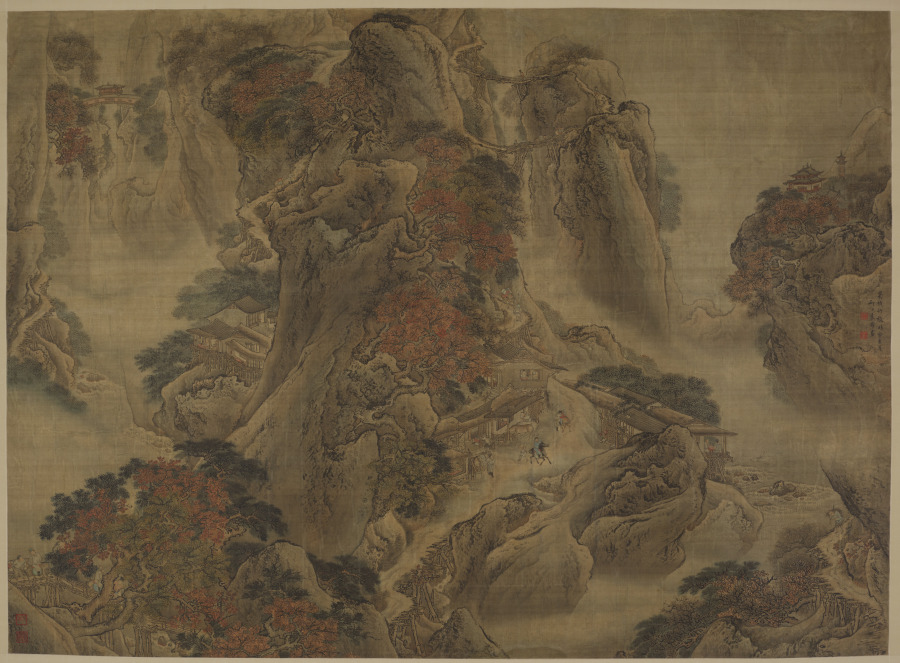
Road to Shu
Yokoi KinkokuLinkedCulture matchlcp-eceac1fa5314
- Date
- early 19th century
- Medium
- Hanging scroll, ink and light color on silk
- Department
- Asian Art
- Institution
- Minneapolis Institute of Art
- Object ID
- 117754
From the Minneapolis Institute of Art record
The road to Shu, the old name of Sichuan Province, was famous for its precarious passages along sheer cliffs. Parts of this road were no wider than a single person and had to be built out on poles from the face of the cliffs. Chinese poets like Li Bai (701–762) composed poems on this hard to manage trail that leads up Mount Emei (Jap. Gabi). One of the Four Buddhist Sacred Mountains of China, Mount Emei is 10, 167 ft. (3, 099 m) tall. Yokoi Kinkoku was a follower of Yosa Buson and imitated him even in his style of calligraphy. He painted in a rapid and spontaneous manner and was especially successful in capturing the vibrancy of mountains and rocks. Toward the end of his life he became a wandering Buddhist priest of the Jōdo (Pure Land) school. Irregularly and richly shaped, the mountains go high up in the painting. Travelers in the foreground are crossing a bridge and we see others at intervals on the slope that climbs up the mountains. Black ink dotting and live-ly outlines give the rocks a rich texture. Japan, Asia
The authoritative record is held by Minneapolis Institute of Art. LinkedCulture surfaces this object and its connections; it does not alter institutional metadata.
Get printable QR codesHide QR codes
Open QR codes for this object page and the museum record. They stay collapsed until needed.
Provenance & credit
As published by the source institution. Coverage varies — not every institution's open-data feed includes ownership history.
- Credit line
- Gift of the Clark Center for Japanese Art & Culture; formerly acquired by the Center with the kind assistance of Carol Brooks and Prof. James Cahill in honor of George Schlenker
Related across collections
Semantically similar works from Minneapolis Institute of Art and other institutions.

Mount Gabi
Minneapolis Institute of Art
#105092
Road to Shu
Cleveland Museum of Art
#357163

Master Dongpo in a Bamboo Hat and Clogs
Minneapolis Institute of Art
#31439

A Scholar Washing his Feet in a Mountain Stream
Minneapolis Institute of Art
#101492

Mount Fuji
Minneapolis Institute of Art
#118750
Streams and Mountains
Cleveland Museum of Art
#160138

The Red Cliff
Minneapolis Institute of Art
#4816
Shower Below the Summit (Sanka hakuu), from the series "Thirty-Six Views of Mount Fuji (Fugaku sanjurokkei)"
Art Institute of Chicago
#87008

Boating on a Snowy Evening
Minneapolis Institute of Art
#117055

“River and Sky in Evening Snow, ” from the Eight Views of the Xiao and Xiang Rivers
Minneapolis Institute of Art
#122115

Scenic Beauty Along Rivers and Mountains
Minneapolis Institute of Art
#187

Early Spring Landscape
Minneapolis Institute of Art
#99427