Art Institute of Chicago
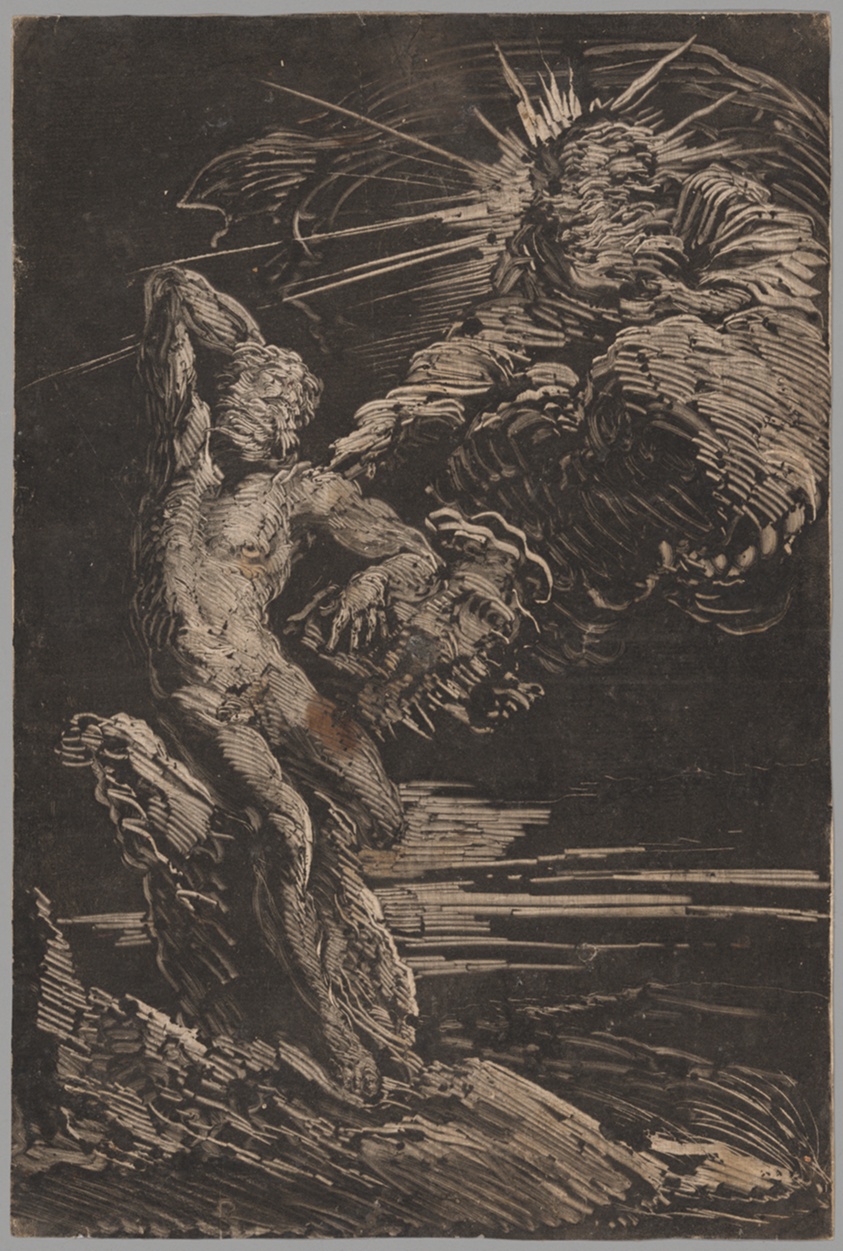
The Creation of Adam
Giovanni Benedetto CastiglioneLinkedCulture matchlcp-d63eba601c72
- Date
- c. 1645/50
- Medium
- Monotype in black ink on ivory laid paper
- Culture
- Italy
- Department
- Prints and Drawings
- Institution
- Art Institute of Chicago
- Object ID
- 105073
From the Art Institute of Chicago record
Considered one of the most original and innovative Italian artists of the Baroque period, Giovanni Benedetto Castiglione literally separated light from darkness, creating form out of chaos in this work, his earliest known monotype. In a perfect match of medium and message, Castiglione, the Genoese artist credited with inventing the technique, used this new method to portray the central act of Genesis: the creation of man. He produced this electrifying image by subtracting the design from the inked surface of a copperplate with a blunt instrument, such as a stick or paintbrush handle, and then printing directly on a sheet of paper. Broad, angular strokes of white depict God emerging from a cloud, while thin, fluid lines extract the languid body of Adam from velvety blackness. Castiglione’s monotypes employ both this dark-ground technique, which naturally lends itself to dramatic and mysterious imagery, and the light-ground manner, in which the design is drawn in ink directly on a clean plate. Both processes yield only one fine impression. It was not until the nineteenth century that such versatile artists as Edgar Degas explored the monotype’s full potential.
The authoritative record is held by Art Institute of Chicago. LinkedCulture surfaces this object and its connections; it does not alter institutional metadata.
Get printable QR codesHide QR codes
Open QR codes for this object page and the museum record. They stay collapsed until needed.
Provenance & credit
As published by the source institution. Coverage varies — not every institution's open-data feed includes ownership history.
- Credit line
- Gift of an anonymous donor; purchased with funds provided by Dr. William D. and Sara R. Shorey, and Mr. and Mrs. George B. Young
- Provenance
- Edward Cavendish, (1895-1950), 10th Duke of Devonshire, Chatworth, Derbyshire, England, by 1925 [Calabi 1925]; by descent to his son, Andrew Cavendish (1920-2004), 11th Duke of Devonshire, Chatworth, Derbyshire, England; Trustees of the Chatworth Settlement, by 1971 [Philadelphia 1971]; sold Christie's, London, Dec. 5, 1985, lot 161, to C.G. Boerner, Düsseldorf, for the Art Institute of Chicago.
Linked open data
Authority identifiers that link this record into the wider web of cultural data — stable references you can follow to the source.
- Object type
- AAT300041273
Related across collections
Semantically similar works from Art Institute of Chicago and other institutions.