Art Institute of Chicago
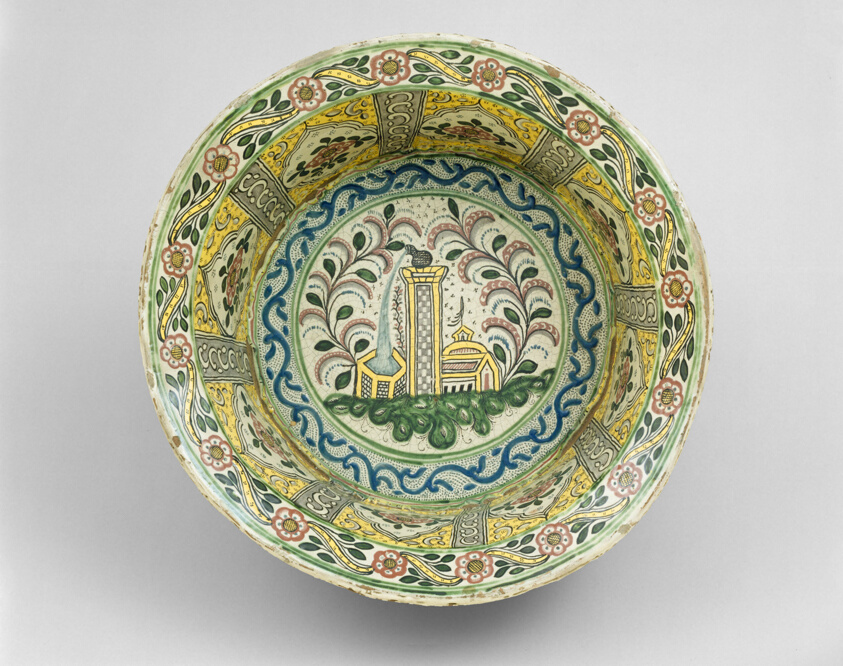
Basin Depicting a Cistern, Tower and Domed Building
Talavera poblanaLinkedCulture matchlcp-9352b5f3092f
- Date
- 1775–1825
- Medium
- Tin-glazed earthenware
- Culture
- Puebla
- Department
- Arts of the Americas
- Institution
- Art Institute of Chicago
- Object ID
- 10607
From the Art Institute of Chicago record
Barely a decade after the Spanish conquered Aztec ( Mexica ) Tenochtitlan (present-day Mexico City) in 1521, they founded the city of Puebla de los Angeles sixty miles to the southeast. As colonial society began to take shape, a new visual environment was called into being, supplanting the major forms of native art and affirming the cultural ascendancy of the ruling order. Ceramics became important in this endeavor, and Puebla emerged as the principal center of a thriving pottery industry that included glazed tableware, secular and religious accessories, and tiles used in architectural ornamentation. The imagery of these objects stemmed from opposite ends of the earth, reflecting a New World synthesis that came into being as the Silk Road became global. Master ceramists from Spain settled in Puebla, bringing with them the potter’s wheel as well as tin-glazed earthenware and Hispano-Moresque ornamentation, both originally rooted in the artistic culture of the Islamic world. Indeed, a primary characteristic of the Spanish tradition can be traced to the formative period of Islamic art, which occurred between 800 and 1000. The artists, artisans, and architects charged with the task of creating a visual culture for the new faith did not immediately invent radically original forms; rather, they incorporated motifs and themes from the art of the Roman, Byzantine, and Persian empires, choosing and adapting from a variety of sources as a new imagery and aesthetic took shape. In Mexico this inheritance, which in ceramic art placed special value on ornamentation and avoided themes fixed by religious scripture, offered an approach to incorporating another unexpected source of artistic inspiration. During the 1560s, Chinese blue-and-white porcelain, along with other Asian luxury goods, began arriving on galleons from Manila, the new capital of the Spanish Philippines. Unloaded in Acapulco, these objects were transported overland to Mexico City and Puebla—where many of them remained—before continuing on to Veracruz and across the Atlantic to Seville. Chinese wares, with their array of figurative, floral, and geometric forms, had an immediate and lasting impact. In Puebla, a new line of production began, featuring glazed earthenwares freely imitating the important porcelains while also retaining patterns and shapes deriving from the old Hispano-Moresque tradition. The Art Institute’s basin reflects this layered artistic inheritance: the shape stems from examples made in Egypt, Syria, and Turkey; the ornament derives from Chinese designs; and the filler details spring from the Hispano-Moresque tradition. For instance, the wide, flaring rim is wreathed with pink flowers linked by leafy, scrolling bands adapted from a Chinese motif. The high wall is divided by panels featuring lobed compartments enclosing simplified Chinese peonies; the surrounding spaces are filled with dotted clusters of Hispano-Moresque origin. The exotic architectural motifs in the central medallion originate in the domed and towered buildings depicted in fanciful Chinese landscape images; here, however, the tower is converted into a fountain surmounted by a native gourd from which water cascades into a cistern. Bold design, vivid color, and playful fantasy characterize this distinctive Mexican synthesis.
The authoritative record is held by Art Institute of Chicago. LinkedCulture surfaces this object and its connections; it does not alter institutional metadata.
Get printable QR codesHide QR codes
Open QR codes for this object page and the museum record. They stay collapsed until needed.
Provenance & credit
As published by the source institution. Coverage varies — not every institution's open-data feed includes ownership history.
- Credit line
- Gift of Eva Lewis in memory of her husband, Herbert Pickering Lewis
- Provenance
- Herbert Pickering Lewis (1876–1922), Mexico City, Mexico, from late 19th/early 20th century [correspondence and research in curatorial object file]; by descent to his widow, Eva Lewis (born Eva Hill, died c. 1964), Mexico City, Mexico, from 1922 [exported from Mexico Oct./Nov. 1923; received in Chicago Dec. 3, 1923 according to correspondence from Eva Lewis to Robert Harshe, Nov. 4, 1923, and incoming permanent receipt R1335, Dec. 3, 1923, copies in curatorial object file, Arts of the Americas]; given to the Art Institute of Chicago, 1923.
Linked open data
Authority identifiers that link this record into the wider web of cultural data — stable references you can follow to the source.
- Object type
- AAT300386308
Related across collections
Semantically similar works from Art Institute of Chicago and other institutions.