Art Institute of Chicago
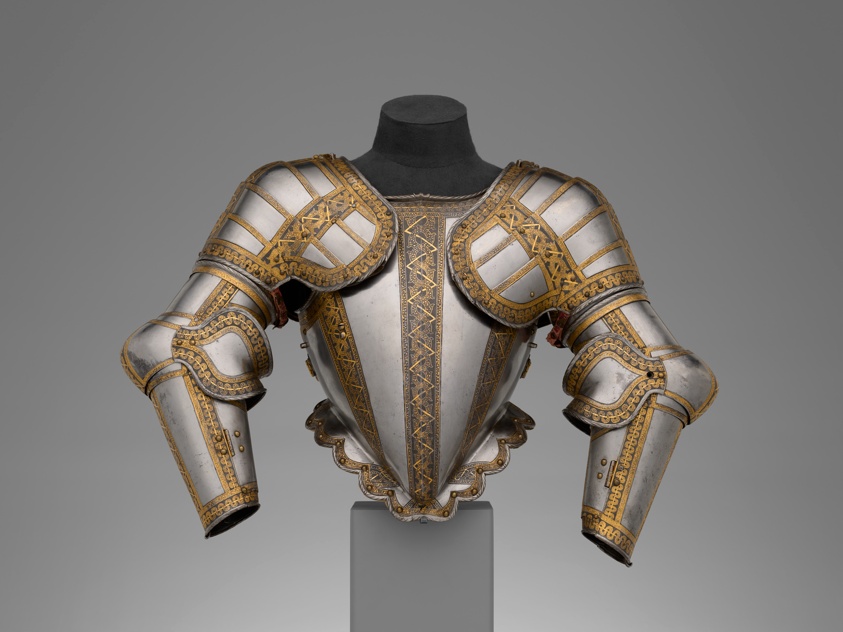
Portions of a Field Armor
Jacob Halder (English, 1558–1608)LinkedCulture matchlcp-e6b985c69dda
- Date
- c. 1588
- Medium
- Steel, brass, gilding, leather, and silk velvet textile
- Culture
- Greenwich
- Department
- Applied Arts of Europe
- Institution
- Art Institute of Chicago
- Object ID
- 106377
From the Art Institute of Chicago record
During the late Middle Ages and Renaissance, some of the finest armorers worked exclusively for royal patrons in the workshops set up to meet their needs. In 1511 King Henry VIII of England established such a workshop at Greenwich Palace outside London, which produced outstanding armor for the English court for over a century. It was staffed largely by German craftsmen, among them Jacob Halder, who was master workman at Greenwich when this half-armor was produced around 1588–90. Made for a high-ranking nobleman, it features crisply decorated bands of etching and gilding and a silhouette mimicking fashionable dress. The shape of the breastplate, broad at the shoulders, narrow at the waist, and dipped at the belly, imitates the peasecod (peapod-shaped) cut of a gentleman’s doublet of the same period. Despite the lavish decoration and exaggerated shape, this armor, intended for the field of battle, was capable of withstanding musket fire. Indeed, it was commissioned in 1588, at the very moment England was preparing for invasion by the Spanish Armada. But to the fashionable noble who commissioned this harness, demonstrating wealth and status was as important as protecting life and limb.
The authoritative record is held by Art Institute of Chicago. LinkedCulture surfaces this object and its connections; it does not alter institutional metadata.
Get printable QR codesHide QR codes
Open QR codes for this object page and the museum record. They stay collapsed until needed.
Provenance & credit
As published by the source institution. Coverage varies — not every institution's open-data feed includes ownership history.
- Credit line
- George F. Harding Collection
- Provenance
- Duke Viktor von Ratibor, castle at Grafenegg; sold Fischer sale, Lucerne, September 2, 1933 to George F. Harding, Jr.; transferred to the George F. Harding Museum; transferred to the Art Institute of Chicago, 1982.
Linked open data
Authority identifiers that link this record into the wider web of cultural data — stable references you can follow to the source.
- Object type
- AAT300209266
Part of a LinkedCulture topic
 European Renaissance Armor Components
These objects are all pieces of defensive armor and military equipment from 15th-17th century Europe, primarily from major armoring centers like Italy, Germany, and France.
500 objects from 4 institutions
Related across collections
Semantically similar works from Art Institute of Chicago and other institutions.