Art Institute of Chicago
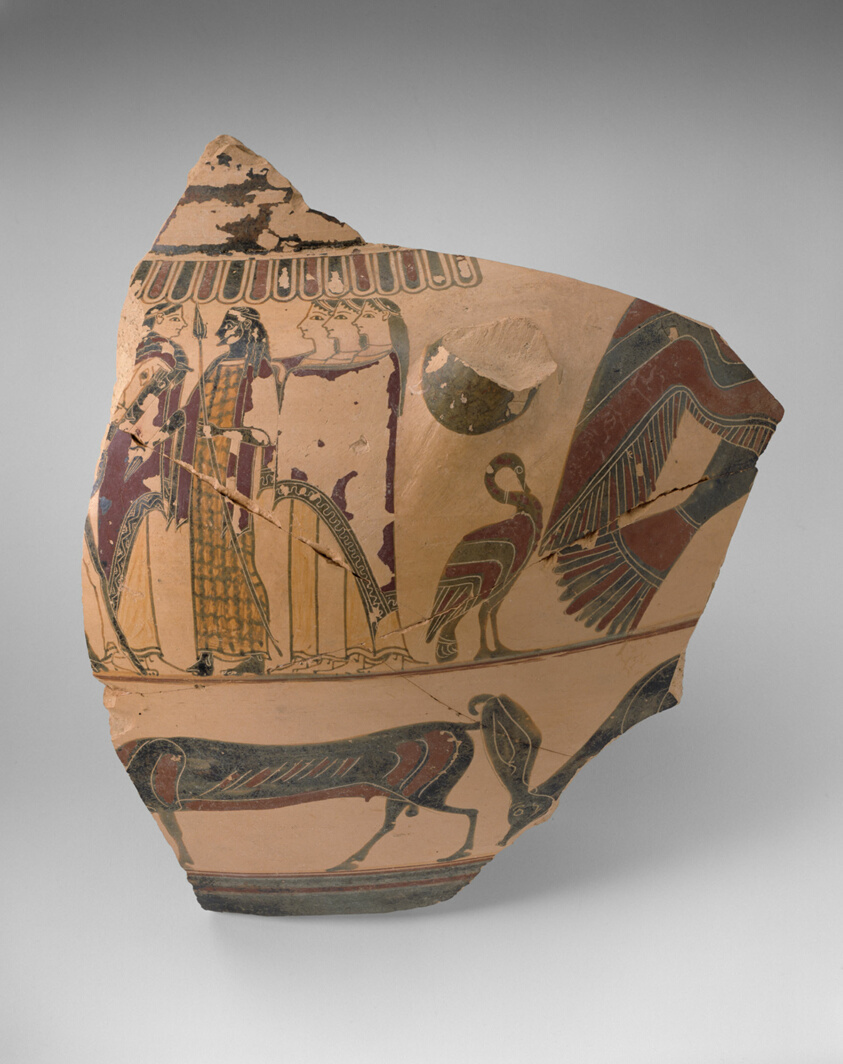
Fragment of a Column Krater (Mixing Bowl)
Attributed to the Cavalcade PainterLinkedCulture matchlcp-b6282b3d1e83
- Date
- 580-570 BCE
- Medium
- terracotta, black-figure
- Culture
- Corinth
- Department
- Arts of Greece, Rome, and Byzantium
- Institution
- Art Institute of Chicago
- Object ID
- 109458
From the Art Institute of Chicago record
This fragment comes from a large bowl that was used to mix wine and water before it was served. Unusually, it is decorated in two techniques. The bearded man holding a spear and the animals to the right and below the scene are decorated in the black-figure technique, but the other figures are simply outlined. The use of yellow for the man’s garment is also unusual. The seventh century marks the beginning of the Archaic period (700–480 BCE). In Corinth, geometric patterns that had embellished the pottery of the preceding era gave way to depictions of animals, both real and imaginary, and sometimes humans and gods. Painters also explored new ways of decorating their pots, including the outline technique. Ultimately, they settled on painting their subjects in silhouette with black gloss and created details by incising through the black to reveal the lighter clay below and sometimes adding reddish-purple or creamy white gloss. This method of decoration is called the black-figure technique.
The authoritative record is held by Art Institute of Chicago. LinkedCulture surfaces this object and its connections; it does not alter institutional metadata.
Get printable QR codesHide QR codes
Open QR codes for this object page and the museum record. They stay collapsed until needed.
Provenance & credit
As published by the source institution. Coverage varies — not every institution's open-data feed includes ownership history.
- Credit line
- Costa A. Pandaleon Endowment
- Provenance
- Atlantis Antiquities, New York, by 1987 [documentation indicates that the object was shipped from Bürki & Sohn, Zurich, Switzerland]; sold to the Art Institute, 1987.
Linked open data
Authority identifiers that link this record into the wider web of cultural data — stable references you can follow to the source.
- Object type
- AAT300193015
Related across collections
Semantically similar works from Art Institute of Chicago and other institutions.