Art Institute of Chicago
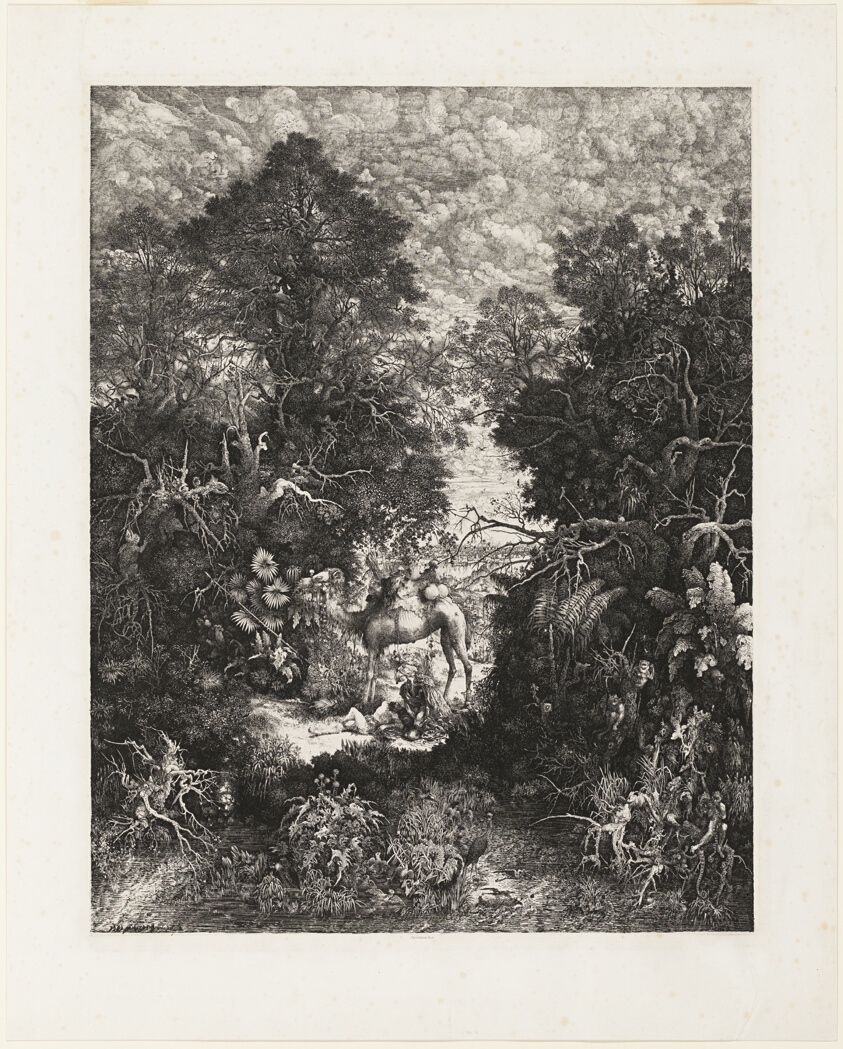
The Good Samaritan
Rodolphe BresdinLinkedCulture matchlcp-1b68b3f7bc24
- Date
- 1861
- Medium
- Lithograph on white China paper laid down on white wove paper
- Culture
- France
- Department
- Prints and Drawings
- Institution
- Art Institute of Chicago
- Object ID
- 109503
From the Art Institute of Chicago record
Considered the masterwork of Bresdin' s career and one of the outstanding lithographs of the nineteenth century, The Good Samaritan relates the parable of the heathen who aided an injured traveller, whom a priest and a Levite had passed by with averted eyes. The work was first exhibited in the state-sponsored Salon of 1861 under the title Abd el-Kader aiding a Christian, in reference to the Muslim hero who personally saved thousands of Christians from Syrian aggression in 1860. While the event surely parallels the biblical tale, Bresdin probably alluded to the well-known contemporary figure of Abd el-Kader as a means to popularize his own religious imagery. Indeed, the print was so well received that it was published in a series of editions, at such profit to the artist that he later referred to the print as "my good Samaritan." This proof was printed early in the first edition, before the lithographic stone began to deteriorate, and is one of the most crisp and successful existing impressions of the print.
The authoritative record is held by Art Institute of Chicago. LinkedCulture surfaces this object and its connections; it does not alter institutional metadata.
Get printable QR codesHide QR codes
Open QR codes for this object page and the museum record. They stay collapsed until needed.
Provenance & credit
As published by the source institution. Coverage varies — not every institution's open-data feed includes ownership history.
- Credit line
- Through prior bequests of Charles Deering, Maxine Kunstadter and Carl O. Schniewind; through prior acquisitions of the Joseph Brooks Fair Endowment, The Carter H. Harrison, Print and Drawing Club and Print Department Purchase Funds; through prior gift of an anonymous donor
Linked open data
Authority identifiers that link this record into the wider web of cultural data — stable references you can follow to the source.
- Object type
- AAT300041273
Related across collections
Semantically similar works from Art Institute of Chicago and other institutions.