Art Institute of Chicago
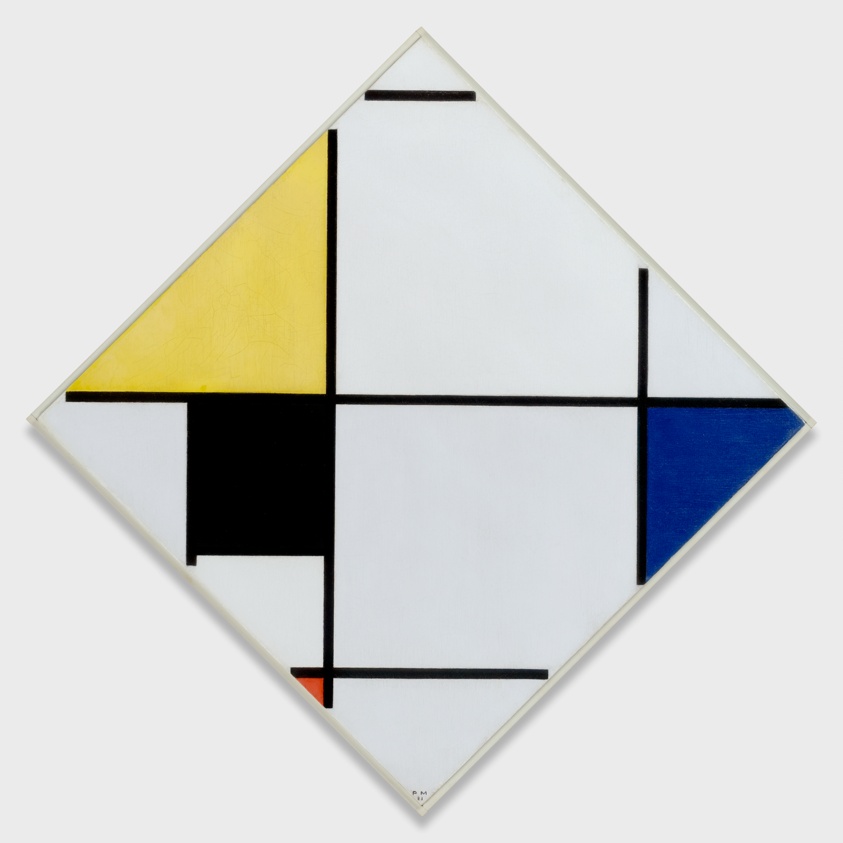
Lozenge Composition with Yellow, Black, Blue, Red, and Gray
Piet MondrianLinkedCulture matchlcp-020392a14ce9
- Date
- 1921
- Medium
- Oil on canvas
- Culture
- Netherlands
- Department
- Modern Art
- Institution
- Art Institute of Chicago
- Object ID
- 109819
From the Art Institute of Chicago record
Piet Mondrian, a painter of the revolutionary international movement De Stijl (the Style), argued that "the straight line tells the truth." Why, then, we might wonder, would he choose to hang a painting off axis, where its edges imply dynamic diagonals? Among other motivations, rotating the canvas allowed Mondrian to reconsider a question he spent his career exploring, namely, the relationship between the contents of a painting and what contains them. In Lozenge Composition , the squared-off black lines imply enclosure, while a single line (above the blue area) extends to the slanted edge, suggesting extension beyond the canvas. This implication of what might lie beyond also prompted Mondrian to invoke the full expanse of the wall by hanging diagonal paintings well above eye level.
The authoritative record is held by Art Institute of Chicago. LinkedCulture surfaces this object and its connections; it does not alter institutional metadata.
Get printable QR codesHide QR codes
Open QR codes for this object page and the museum record. They stay collapsed until needed.
Provenance & credit
As published by the source institution. Coverage varies — not every institution's open-data feed includes ownership history.
- Credit line
- Gift of Edgar Kaufmann, Jr.
- Provenance
- Consigned to Galerie de “L’Effort Moderne” (Léonce Rosenberg), Paris, 1921-22. Jakob von Domselaer and Maaike von Domselaer-Middelkoop, Bergen, the Netherlands, 1922(?)-1940/45. John Rädecker, Groet, the Netherlands, 1940/45-c. 1948. John L. Senior, Jr., New York, by 1949-1956 [letter from Sidney Janis Gallery in curatorial file]. Sidney Janis Gallery, New York, 1956. Edgar Kaufmann, Jr., New York, March 1, 1957; given to the Art Institute, 1957.
Linked open data
Authority identifiers that link this record into the wider web of cultural data — stable references you can follow to the source.
- Object type
- AAT300033618
Related across collections
Semantically similar works from Art Institute of Chicago and other institutions.