Art Institute of Chicago
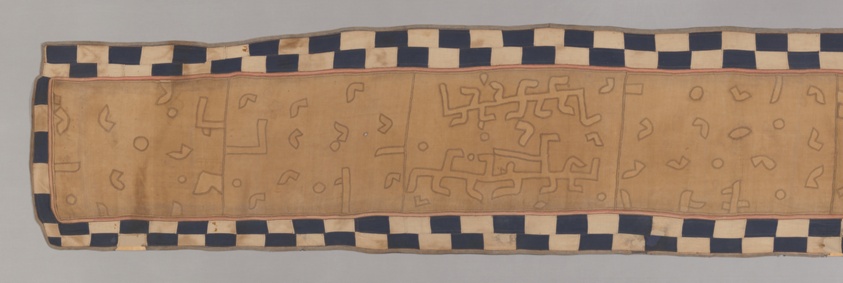
Ceremonial Skirt
Bushong, KubaLinkedCulture matchlcp-8bbc89423a5d
- Date
- Late 19th century
- Medium
- Raffia, plain weaves; pieced; appliquéd with plain weaves in pearl stitches; embroidered in pearl stitches; edged with bands of cotton, warp-stripe warp-float faced twill weave; cotton, plain weave; pieced and hemmed in slip and pearl stitches; and cotton, warp-float faced alternating float weave; joined with raffia in pearl and twisted insertion stitches
- Culture
- Democratic Republic of the Congo
- Department
- Textiles
- Institution
- Art Institute of Chicago
- Object ID
- 110058
From the Art Institute of Chicago record
Individually worked panels were sewn together to create this expansive skirt embellished with a kinetic array of patterns. The central floating motifs add lightness, especially when contrasted with the black-and-white checkerboard edge. Kuba men are responsible for preparing and weaving raffia, while Kuba women cut the appliqúe shapes freehand to decorate the cloth. To make a skirt of this size, several women from the same extended family would construct different sections. The abstract forms may represent stylized humans, animals, plants, and objects. Constituting a kind of encrypted script, the repeating motifs—including circles, lozenges, and L-shapes—function as building blocks for the entire design. The comma-like shape that appears across parts of the skirt is called ishina'mbua, which translates as "dog's tail"—a symbolic reference to the animal's keen sense of smell and vision as well as the spiritual qualities that the Kuba associate with the animal.
The authoritative record is held by Art Institute of Chicago. LinkedCulture surfaces this object and its connections; it does not alter institutional metadata.
Get printable QR codesHide QR codes
Open QR codes for this object page and the museum record. They stay collapsed until needed.
Provenance & credit
As published by the source institution. Coverage varies — not every institution's open-data feed includes ownership history.
- Credit line
- Edward E. Ayer Endowment, a memorial to Charles L. Hutchinson by his great friend and admirer; Samuel P. Avery and Maurice D. Galleher endowments
- Provenance
- Andrés Moraga, San Francisco, CA, by Apr. 11, 1985 [incoming receipt RX15477, Apr. 11, 1985; copy in curatorial object file]; sold to the Art Institute of Chicago, 1985.
Linked open data
Authority identifiers that link this record into the wider web of cultural data — stable references you can follow to the source.
- Object type
- AAT300312158
Related across collections
Semantically similar works from Art Institute of Chicago and other institutions.