Art Institute of Chicago
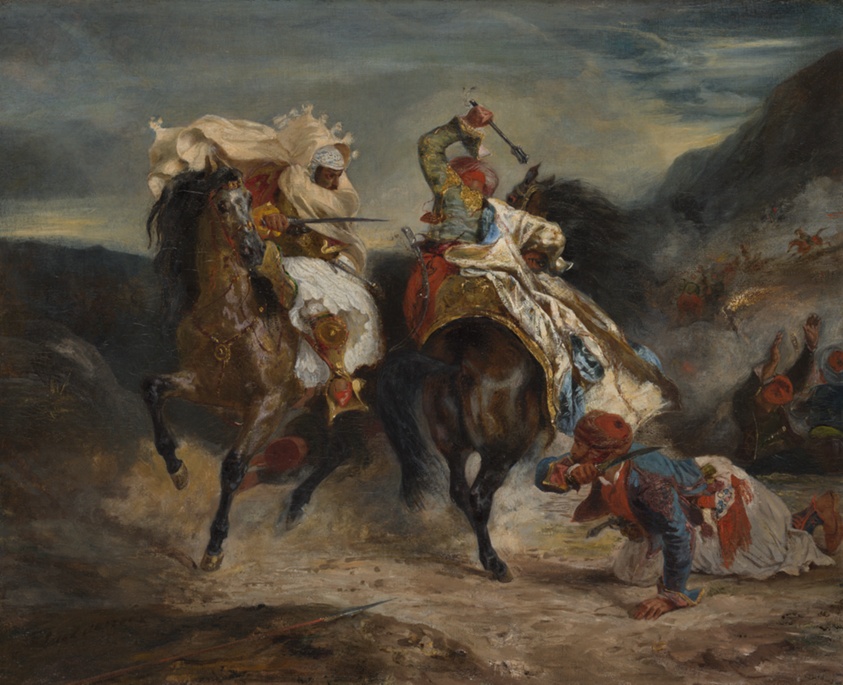
The Combat of the Giaour and Hassan
Eugène Delacroix (French, 1798–1863)LinkedCulture matchlcp-ff01cec55b2b
- Date
- 1826
- Medium
- Oil on canvas
- Culture
- France
- Department
- Painting and Sculpture of Europe
- Institution
- Art Institute of Chicago
- Object ID
- 110663
From the Art Institute of Chicago record
For this frenetic scene, Eugène Delacroix took inspiration from “The Giaour,” a poem in a popular series of romantic tales by the celebrated English poet Lord Byron. Giaour is a derogatory Turkish word for a Christian or non-Muslim applied here to the warrior at left clad in swirling white drapery. Amid a violent struggle, the Giaour is avenging the death of his lover at the hands of his opponent. Delacroix mirrored the two central figures and their horses as the Giaour is about to strike the fatal blow against the faceless Turk Hassan. The artist’s mastery of color is exemplified by his use of shimmering primary hues, while the loose handling of paint creates the sense of dynamism Delacroix was so capable of executing. This painting reflects Delacroix’s sustained engagement with Orientalism, the artistic representation of non-European people and places, especially North Africa, Asia, and the Middle East. Delacroix was among the first European artists to travel to Africa when he visited Morocco in 1832, shortly after he completed this painting. Widespread in the nineteenth century, Orientalism was regularly leveraged to reinforce French colonial enterprises through often fantastical, violent, or erotic depictions of the customs and cultures of faraway locales.
The authoritative record is held by Art Institute of Chicago. LinkedCulture surfaces this object and its connections; it does not alter institutional metadata.
Get printable QR codesHide QR codes
Open QR codes for this object page and the museum record. They stay collapsed until needed.
Provenance & credit
As published by the source institution. Coverage varies — not every institution's open-data feed includes ownership history.
- Credit line
- Gift of Bertha Palmer Thorne, Rose Movius Palmer, Mr. and Mrs. Arthur M. Wood, and Mr. and Mrs. Gordon Palmer
Linked open data
Authority identifiers that link this record into the wider web of cultural data — stable references you can follow to the source.
- Object type
- AAT300033618
Part of a LinkedCulture topic
 French Equestrian Lithography
These prints are connected by their French origin, lithographic printing technique, and shared subject matter depicting horses, riders, and military cavalry scenes from the 19th century.
77 objects from 5 institutions
Related across collections
Semantically similar works from Art Institute of Chicago and other institutions.