Art Institute of Chicago
Stack of Wheat
Claude Monet (French, 1840–1926)LinkedCulture matchlcp-8e614afd9c71
- Date
- 1890–91
- Medium
- Oil on canvas
- Culture
- France
- Department
- Painting and Sculpture of Europe
- Institution
- Art Institute of Chicago
- Object ID
- 111318
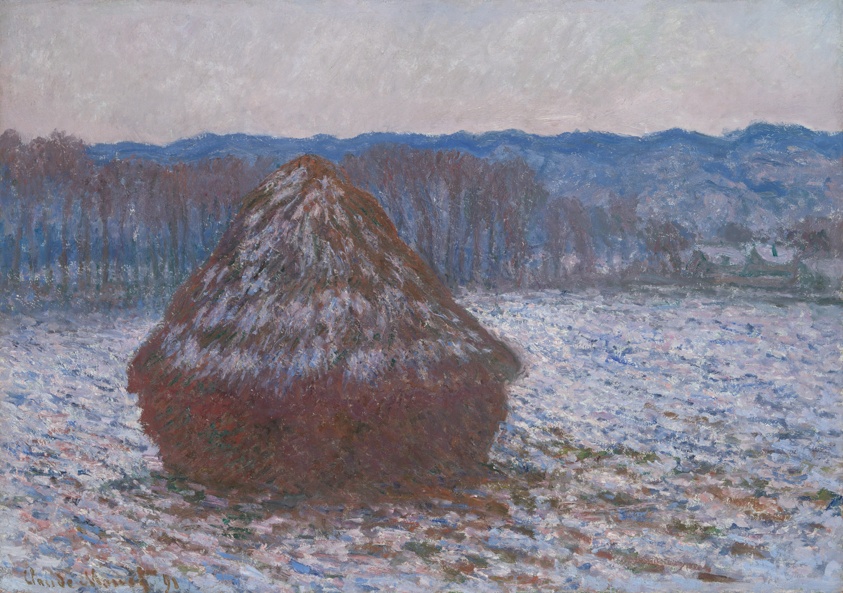
The monumental stacks that Claude Monet depicted in his series Stacks of Wheat rose fifteen to twenty feet and stood just outside the artist’s farmhouse at Giverny. Through 1890 and 1891, he worked on this series both in the field, painting simultaneously at several easels, and in the studio, refining pictorial harmonies. In May 1891, Monet hung fifteen of these canvases next to each other in one small room in the Galerie Durand-Ruel in Paris. An unprecedented critical and financial success, the exhibition marked a breakthrough in Monet’s career, as well as in the history of French art. In this view, and in nearly all of the autumn views in the series, the conical tops of the stacks break the horizon and push into the sky. But in most of the winter views, which constitute the core of the series, the stacks seem wrapped by bands of hill and field, as if bedded down for the season. For Monet, the stack was a resonant symbol of sustenance and survival. He followed this group with further series depicting poplars, the facade of Rouen Cathedral, and, later, his own garden at Giverny. The Art Institute has the largest group of Monet’s Stacks of Wheat in the world.
The authoritative record is held by Art Institute of Chicago. LinkedCulture surfaces this object and its connections; it does not alter institutional metadata.
Get printable QR codesHide QR codes
Open QR codes for this object page and the museum record. They stay collapsed until needed.
Provenance & credit
As published by the source institution. Coverage varies — not every institution's open-data feed includes ownership history.
- Credit line
- Purchased with funds provided by the Searle Family Trust; Major Acquisitions Centennial Endowment; through prior acquisitions of the Mr. and Mrs. Martin A. Ryerson and Potter Palmer collections; through prior bequest of Jerome Friedman
- Provenance
- The artist (d. 1926); possibly sold to Isidore Montaignac, Paris, May 1899 [per Wildenstein 1996; the painting may have been sold as Meule, temps gris. According to Brettell 1984, the painting was acquired by Bertha Honoré Palmer, Chicago, by 1892]. Bertha Honoré Palmer (d. 1918), Chicago [per Brettell 1984]; by descent to the Palmer family; by descent to Pauline Wood (née Palmer), by Oct. 1951 [per shipping out order A647, on file in Museum Registration]. Acquavella Galleries, New York, probably 1982 [per Tiffany Johnston, Art Institute of Chicago, telephone conversation with Jean Edmonson, Acquavella Galleries, Apr. 26, 2002; see notes in curatorial file]; sold to the Art Institute of Chicago, 1983.
Linked open data
Authority identifiers that link this record into the wider web of cultural data — stable references you can follow to the source.
- Object type
- AAT300033618
Related across collections
Semantically similar works from Art Institute of Chicago and other institutions.