Art Institute of Chicago
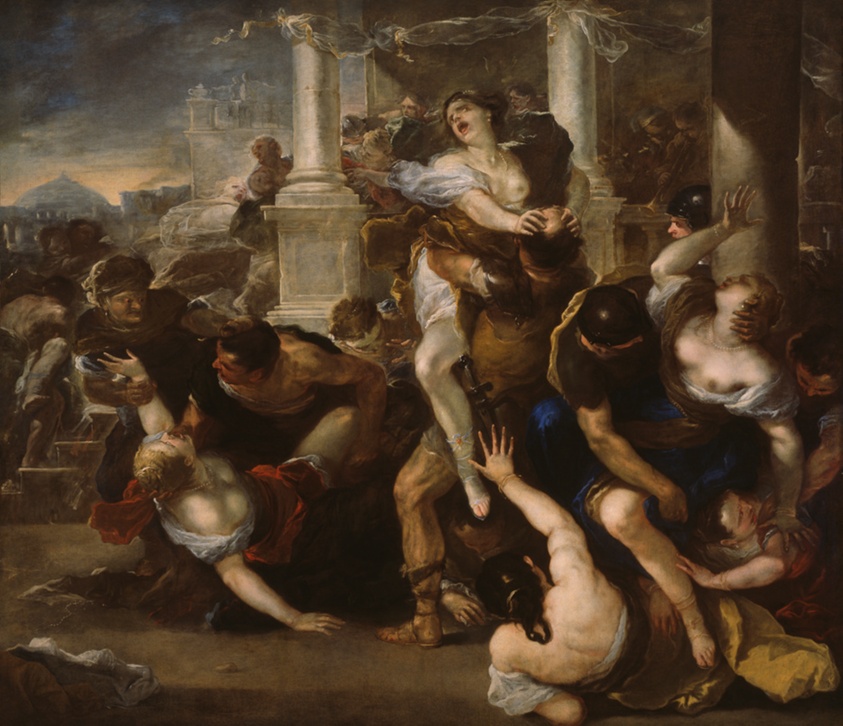
The Abduction of the Sabine Women
Luca Giordano (Italian, 1632–1705)LinkedCulture matchlcp-017df20b20bc
- Date
- c. 1675
- Medium
- Oil on canvas
- Culture
- Italy
- Department
- Painting and Sculpture of Europe
- Institution
- Art Institute of Chicago
- Object ID
- 111620
From the Art Institute of Chicago record
Perhaps the most acclaimed and well-traveled artist in Italy at the end of the 17th century, Luca Giordano first emulated, then transformed the styles of numerous celebrated artists, including Peter Paul Rubens . Giordano’s artistic studies informed this monumental depiction of the myth of the founding of Rome. The Romans, plagued by a shortage of brides, invited the neighboring Sabines to a festival and then violently kidnapped their young women. Using the rapid, bold brushwork that earned him the nickname Luca fa presto (Luca paints quickly), Giordano wove vivid gestures and compositional inspiration from earlier treatments of the subject into one of his most theatrical and geometrically complex works.
The authoritative record is held by Art Institute of Chicago. LinkedCulture surfaces this object and its connections; it does not alter institutional metadata.
Get printable QR codesHide QR codes
Open QR codes for this object page and the museum record. They stay collapsed until needed.
Provenance & credit
As published by the source institution. Coverage varies — not every institution's open-data feed includes ownership history.
- Credit line
- Major Acquisitions Centennial Endowment; Charles H. and Mary F. S. Worcester Collection
- Provenance
- Purchased in the early twentieth century by Georges de Branconier, Brussels [letter from Yvan Cruysmans, dated July 24, 1991, in curatorial file]; Madame Georges de Braconier (née Comtesse d’Hemricourt), Brussels, until 1950s [see letter cited above]; Jean Cruysmans (died 1970), Brussels [see letter cited above]; Cruysmans family, Brussels [see letter cited above]; offered for sale, Sotheby’s, London, March 19, 1975, lot 76; bought in; reoffered Sotheby’s, London, May 12, 1976, lot 102; Alfredo and Raquel Helegua, Washington; sold to the Art Institute, 1991.
Linked open data
Authority identifiers that link this record into the wider web of cultural data — stable references you can follow to the source.
- Object type
- AAT300033618
Related across collections
Semantically similar works from Art Institute of Chicago and other institutions.