Art Institute of Chicago
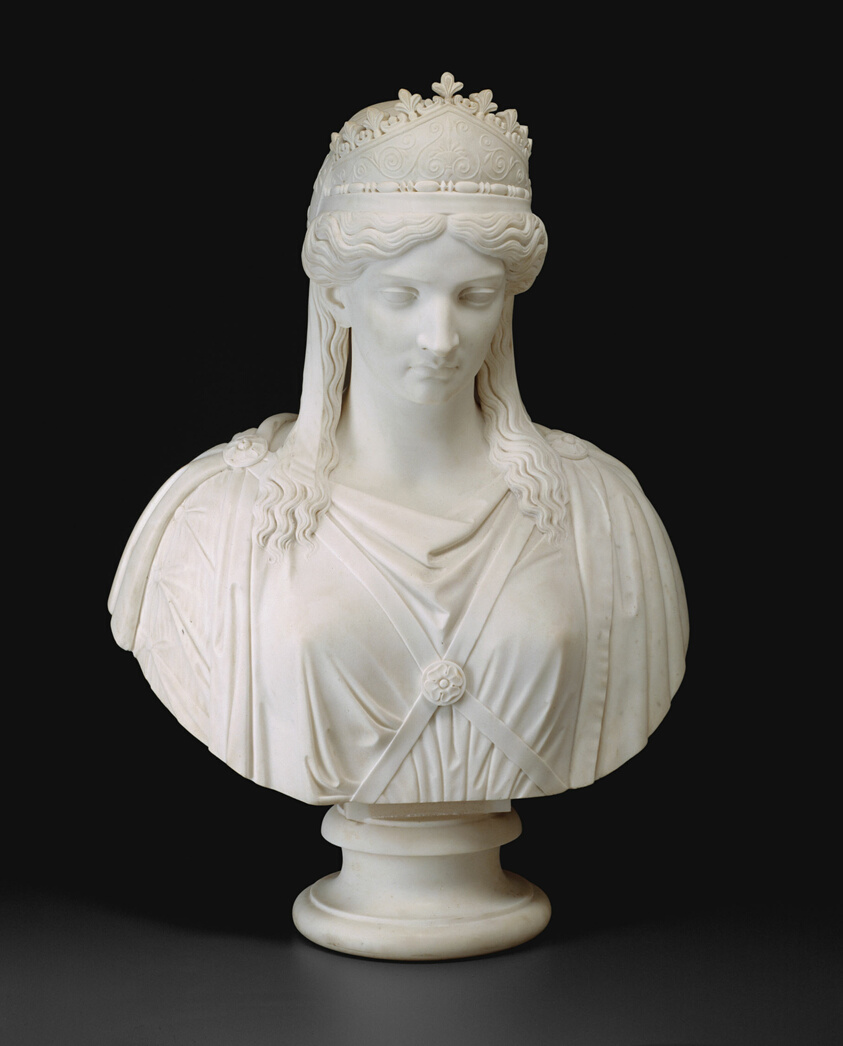
Zenobia, Queen of Palmyra
Harriet Hosmer (American, 1830–1908)LinkedCulture matchlcp-9bd5af1625dd
- Date
- modeled c. 1859; carved after 1859
- Medium
- Marble
- Culture
- United States
- Department
- Arts of the Americas
- Institution
- Art Institute of Chicago
- Object ID
- 125652
From the Art Institute of Chicago record
Zenobia was queen of the Syrian city of Palmyra and ruled it after her husband’s death in the third century. Harriet Hosmer portrayed Zenobia at the moment of her capture and defeat by the Roman emperor Aurelian in 272 CE. Rather than depict a scene of heightened drama, the sculp-tor opted for a quieter sense of grandeur, remarking, “I have tried to make her too proud to exhibit passion or emotion of any kind; not subdued, though a prisoner; but calm, grand, and strong within herself.” Hosmer was the leader of a group of women sculptors in Rome beginning in the 1850s. Many of her works feature strong, independent women drawn from history or literature.
The authoritative record is held by Art Institute of Chicago. LinkedCulture surfaces this object and its connections; it does not alter institutional metadata.
Get printable QR codesHide QR codes
Open QR codes for this object page and the museum record. They stay collapsed until needed.
Provenance & credit
As published by the source institution. Coverage varies — not every institution's open-data feed includes ownership history.
- Credit line
- Purchased with funds provided by the Antiquarian Society
- Provenance
- Conner-Rosenkranz, New York, by 1993; sold to the Art Institute of Chicago, 1993.
Linked open data
Authority identifiers that link this record into the wider web of cultural data — stable references you can follow to the source.
- Object type
- AAT300301253
Related across collections
Semantically similar works from Art Institute of Chicago and other institutions.