Art Institute of Chicago
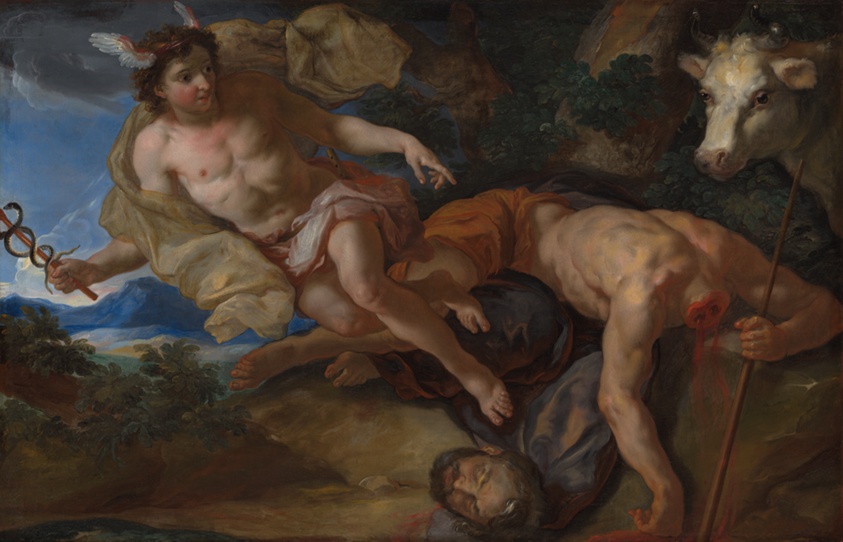
Mercury Rescues the Disguised Io after Beheading Argus
Johann Michael Rottmayr (Austrian, 1654–1730)LinkedCulture matchlcp-9c64d6849524
- Date
- c. 1695
- Medium
- Oil on canvas
- Culture
- Austria
- Department
- Painting and Sculpture of Europe
- Institution
- Art Institute of Chicago
- Object ID
- 12875
From the Art Institute of Chicago record
Johann Michael Rottmayr began painting ambitious series like this one in his native Salzburg, Austria, after returning from several years of artistic training in Venice. His new works featured mythological subjects, energetic compositions, and a saturated palette—the same qualities that inspired Flemish Baroque artists. Here, the Roman god Mercury has beheaded the guardsman Argus, whose crimson blood pours out from his neck onto the ground below. Mortal Io, who has been transformed into a cow by her lover Jupiter, looks on placidly as Mercury rescues her from her imprisonment by Jupiter’s jealous wife, Juno.
The authoritative record is held by Art Institute of Chicago. LinkedCulture surfaces this object and its connections; it does not alter institutional metadata.
Get printable QR codesHide QR codes
Open QR codes for this object page and the museum record. They stay collapsed until needed.
Provenance & credit
As published by the source institution. Coverage varies — not every institution's open-data feed includes ownership history.
- Credit line
- Gift of Jacob S. Sherman
- Provenance
- Unknown Illinois banker; given by banker to Jacob S. Sherman, Chicago, during the 1930s as collateral for a loan that was never repaid [according to Robert Parker Sherman, son of Jacob S. Sherman, telephone conversation with Martha Wolff, 23 July 2003, transcribed in curatorial file]; bequeathed by Jacob S. Sherman (died 1961) to the Art Institute, 1961.
Linked open data
Authority identifiers that link this record into the wider web of cultural data — stable references you can follow to the source.
- Object type
- AAT300033618
Related across collections
Semantically similar works from Art Institute of Chicago and other institutions.