Art Institute of Chicago
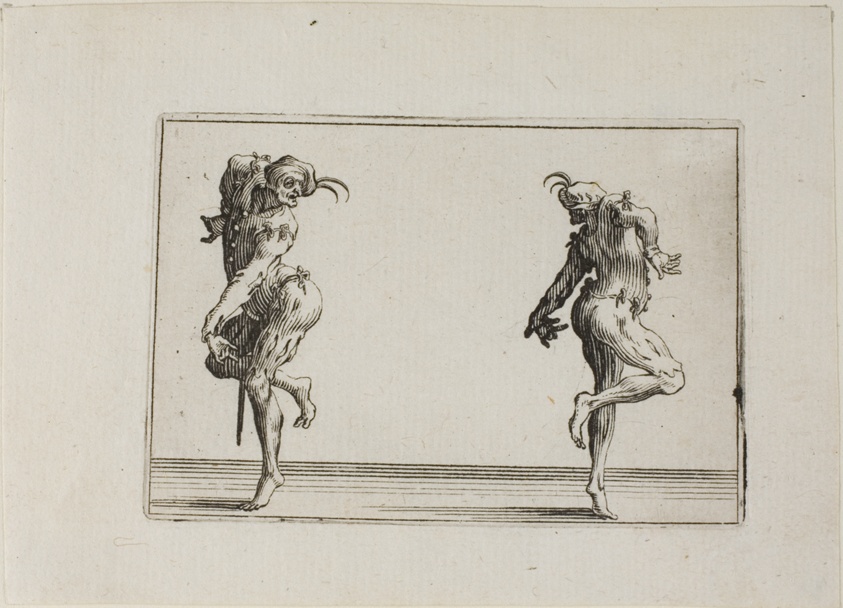
The Two Pantaloons Turning their Back, from The Caprices
Jacques Callot
- Date
- c. 1622
- Medium
- Etching in black on ivory laid paper
- Culture
- France
- Department
- Prints and Drawings
- Institution
- Art Institute of Chicago
In the 17th century, the word capriccio generally indicated a musical composition that thwarted listeners’ expectations with sudden changes in tempo, rhythm, or structure that appeared to be made according to the performer’s whim, or caprice. Jacques Callot borrowed the term to describe a series of etchings with a wide variety of diverting subjects including peasants, architectural sites, military maneuvers, and musicians. Among other motifs, he depicted two pairs of dancers frolicking and playing musical instruments and a shepherd playing a flute.
The authoritative record is held by Art Institute of Chicago. LinkedCulture surfaces this object and its connections; it does not alter institutional metadata.
Linked open data
Authority identifiers that link this record into the wider web of cultural data — stable references you can follow to the source.
- Object type
- AAT300041273
Related across collections
Semantically similar works from Art Institute of Chicago and other institutions.

Après la Révolution, 1795
Musée Carnavalet, Histoire de Paris

Après la révolution, 1795
Musée Carnavalet, Histoire de Paris

Hybride : Galères/Menus plaisirs du roi, 1705
Musée Carnavalet, Histoire de Paris

Les Horaces et les Curiaces, 1793
Musée Carnavalet, Histoire de Paris

Cabaretiers, 1650
Musée Carnavalet, Histoire de Paris

Cabaretiers, 1650
Musée Carnavalet, Histoire de Paris
Jeton satirique anglais, 1796
Musée Carnavalet, Histoire de Paris

Pandora's breeches, 1793
Musée Carnavalet, Histoire de Paris

Jardiniers, 1556
Musée Carnavalet, Histoire de Paris
Deux chapiteaux d'un pilier de colonnettes engagées
Musée Carnavalet, Histoire de Paris

Patissiers-oublayers, 1770
Musée Carnavalet, Histoire de Paris
Pandoras breeches, 1793
Musée Carnavalet, Histoire de Paris