Art Institute of Chicago
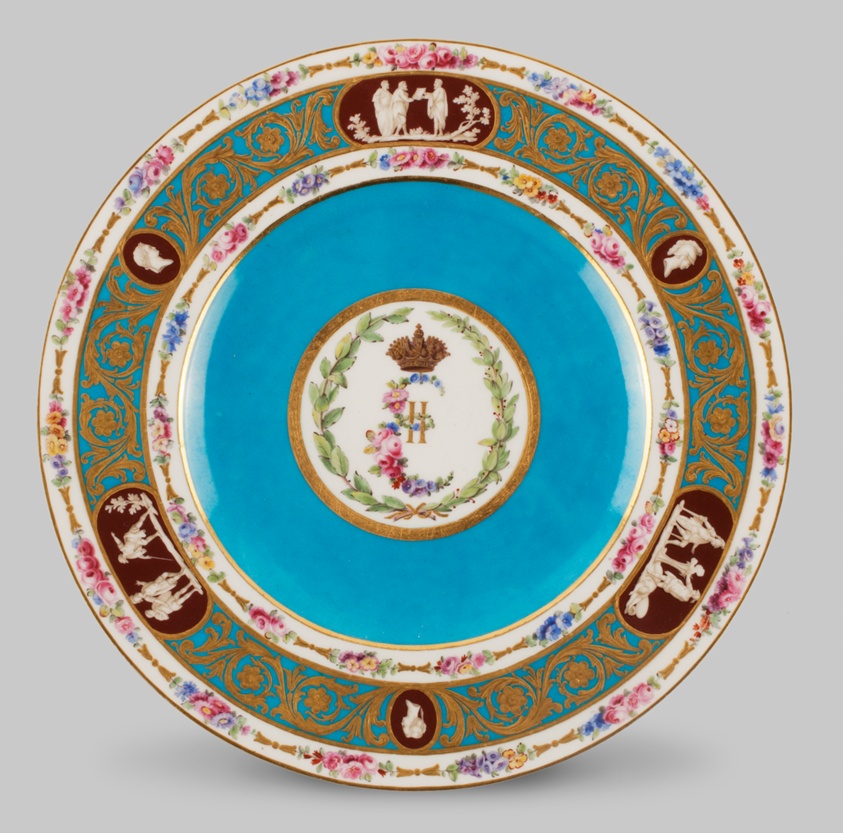
Plate ordered by Empress Catherine II of Russia
Sèvres Porcelain Manufactory (1756–present)LinkedCulture matchlcp-ee31089ce69a
- Date
- 1778
- Medium
- Soft-paste porcelain, turquoise-blue ground, polychrome enamels, and gilding
- Culture
- Sèvres
- Department
- Applied Arts of Europe
- Institution
- Art Institute of Chicago
- Object ID
- 142418
From the Art Institute of Chicago record
This striking plate is part of a dinner service commissioned by the Russian Empress Catherine II, called Catherine the Great (reigned 1761–96). The complete set of eight hundred pieces included sixty place settings, tea and coffee services, a centerpiece with figures representing the Arts and Sciences in biscuit (unglazed porcelain), and numerous architectural elements. The empress gave the commission to the Sèvres porcelain manufactory in mid-1776 through the Russian ambassador in Paris, commanding that it be “in the best and newest style”—what we call Neoclassicism. The plate is marked with the monogram E II (for Ekaterina, the Russian form of Catherine; she was the second queen by this name), surmounted by the Russian imperial crown and encircled by branches of laurel, sacred to Apollo, the Greco-Roman god of the arts, and myrtle, sacred to Venus, the goddess of love. The plates were further enriched by a turquoise ground that imitated the semi-precious stone, and rimmed with representations of Classical cameos, which Catherine collected. Profile heads alternate with scenes from ancient Roman history: King Numa Pompilius presenting laws to the Roman people; the soldier Mucius Scevola burning his own hand to show his contempt for the Etruscan conqueror, Porsenna; and the general Popilius Laenas confronting the Syrian king Antiochus.
The authoritative record is held by Art Institute of Chicago. LinkedCulture surfaces this object and its connections; it does not alter institutional metadata.
Get printable QR codesHide QR codes
Open QR codes for this object page and the museum record. They stay collapsed until needed.
Provenance & credit
As published by the source institution. Coverage varies — not every institution's open-data feed includes ownership history.
- Credit line
- Purchased with funds provided by Dorothy Hale Dunbar, Mr. and Mrs. Samuel Grober, Mr. and Mrs. Stanford D. Marks, Mrs. Eric Oldberg, Harry A. Root, Jr., and the Antiquarian Society through bequests of Lena Gilbert, Harriet Jones, Jessie Landon, Adelaide Ryerson, and the Margaret C. and James D. Vail Fund in memory of her mother, Margaret Arronet Corbin
Linked open data
Authority identifiers that link this record into the wider web of cultural data — stable references you can follow to the source.
- Object type
- AAT300386308
Related across collections
Semantically similar works from Art Institute of Chicago and other institutions.