Art Institute of Chicago
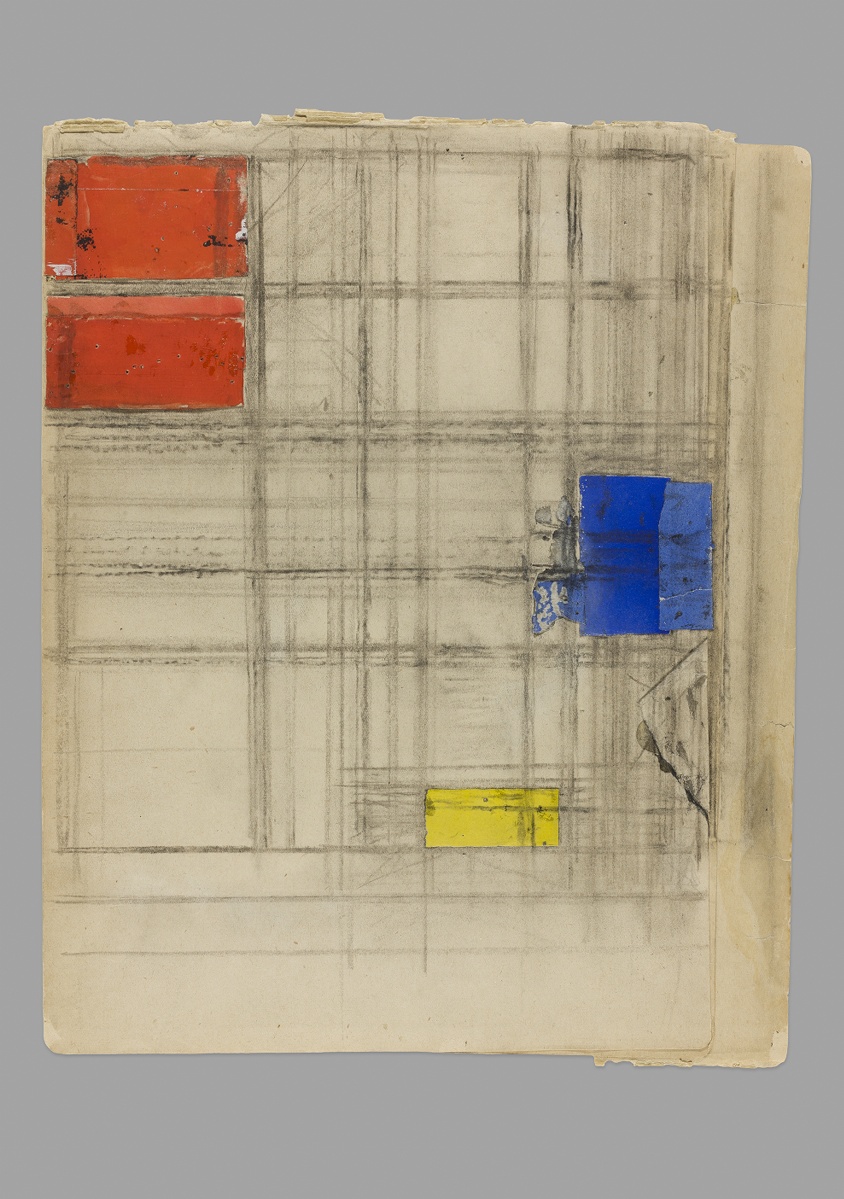
Study for a Composition
Piet MondrianLinkedCulture matchlcp-020392a14ce9
- Date
- 1940–41
- Medium
- Collage of cut and pasted papers, prepared with gouache and charcoal, on pieced cream wove newsprint in three parts with charcoal on verso
- Culture
- Netherlands
- Department
- Prints and Drawings
- Institution
- Art Institute of Chicago
- Object ID
- 142570
From the Art Institute of Chicago record
In 1916, after a long search for an entirely new visual vocabulary to represent the physical world, Piet Mondrian arrived at a fully abstract style. He reduced bridges, churches, rivers, trees, and more to a series of horizontal and vertical black lines enclosing fields of unmixed red, blue, and yellow as well as white, black, and gray. This artistic idiom, eventually called Neoplasticism, removed naturalism from painting to reveal the essence of visual forms and provide viewers with a transcendental experience. While Mondrian’s abstractions may seem simple, he worked hard to achieve the dynamic yet harmonious balance between line and color. He labored over the location, spacing, and thickness of every line, making numerous charcoal sketches both on paper and directly on the canvas. Although not immediately related to any finished painting, Study for a Composition shows the artist’s obsession with the density and placement of line and the number, size, and location of color fields. Here, he collaged red and blue papers to the sheet to examine their weight and position in relation to other elements. This work is the only known surviving study by Mondrian with colored collage elements.
The authoritative record is held by Art Institute of Chicago. LinkedCulture surfaces this object and its connections; it does not alter institutional metadata.
Get printable QR codesHide QR codes
Open QR codes for this object page and the museum record. They stay collapsed until needed.
Provenance & credit
As published by the source institution. Coverage varies — not every institution's open-data feed includes ownership history.
- Credit line
- Gift of Dorothy Braude Edinburg to the Harry B. and Bessie K. Braude Memorial Collection
- Provenance
- Bequeathed by the artist to his friend, Harry Holtzman (1912-1987), New York; Harry Holtzman, to 1964 [according to Joosten 1998]. Marlborough-Gerson Gallery, New York, by April 1964 [New York 1964 exh. cat.]; sold by Marlborough-Gerson Gallery to Dorothy Braude Edinburg, Brookline, Mass., May 29, 1969; given to the Art Institute of Chicago, 2013.
Linked open data
Authority identifiers that link this record into the wider web of cultural data — stable references you can follow to the source.
- Object type
- AAT300033973
Related across collections
Semantically similar works from Art Institute of Chicago and other institutions.