Art Institute of Chicago
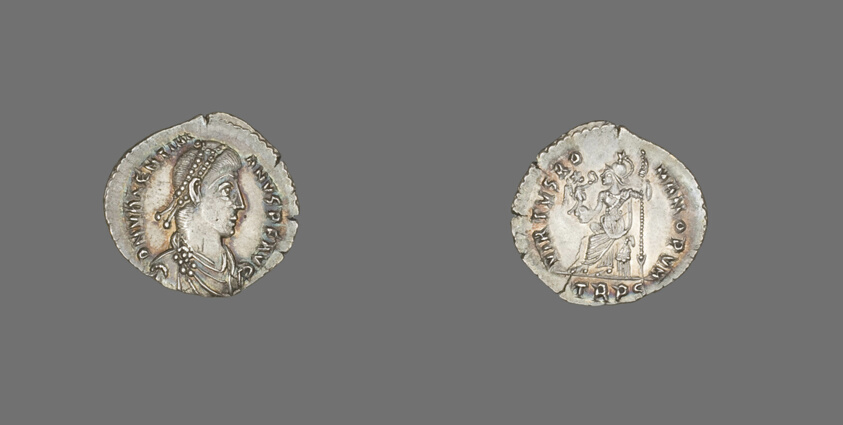
Siliqua (Coin) Portraying Valentinian II
Roman, minted in TrierLinkedCulture matchlcp-17d6b6ad3fbe
- Date
- 378-383
- Medium
- Silver
- Culture
- Trier
- Department
- Arts of Greece, Rome, and Byzantium
- Institution
- Art Institute of Chicago
- Object ID
- 145236
From the Art Institute of Chicago record
The front (obverse) of this coin portrays Emperor Valentinian II, diademed, draped, and cuirassed (wearing a military cloak), facing right. The back (reverse) depicts Roma seated on a throne, holding Victory on globe and spear. Although the fourth century was a time of tremendous political, social, and religious change for the Roman Empire, the imagery presented on the coins tells a different story, one of an unbroken chain of powerful rulers supported by the deities of traditional Roman religion. Diocletian (reigned 284–305), through a series of administrative, military, and monetary reforms, had brought to an end the chaos of the third century. He also divided the rule of the vast empire under four men, a senior and junior ruler in the Western half and the Eastern half. Constantine I (reigned 306–37) reinstituted sole control over the empire; moved the imperial capital to the new city named after him, Constantinople; and not only brought an end to the persecution of Christians, but also built monumental churches in Rome, Constantinople, and Jerusalem. In 380, Theodosius (reigned 379–95) proclaimed Christianity as the official religion of the Empire. His coin in this case, however, stands true to numismatic tradition; a personification of Fortune appears on the back of his coin.
The authoritative record is held by Art Institute of Chicago. LinkedCulture surfaces this object and its connections; it does not alter institutional metadata.
Get printable QR codesHide QR codes
Open QR codes for this object page and the museum record. They stay collapsed until needed.
Provenance & credit
As published by the source institution. Coverage varies — not every institution's open-data feed includes ownership history.
- Credit line
- Gift of Mr. Roger Trienens
- Provenance
- Spink & Son, Ltd. London through Galerie des Monnaies, Geneva, October 10, 1977, lot 500; sold to Roger Trienens, Saratoga Springs, NY; given to the Art Institute of Chicago, 1996.
Linked open data
Authority identifiers that link this record into the wider web of cultural data — stable references you can follow to the source.
- Object type
- AAT300037334
Related across collections
Semantically similar works from Art Institute of Chicago and other institutions.