Art Institute of Chicago
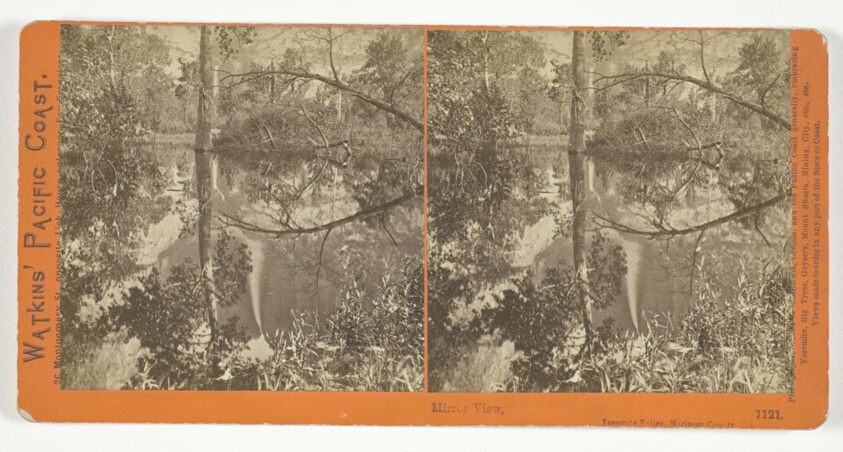
Mirror View, Yosemite Valley, Mariposa County, Cal.
Carleton E. WatkinsLinkedCulture matchlcp-62175c414718
- Date
- 1861/76
- Medium
- Albumen print, stereo
- Culture
- United States
- Department
- Photography and Media
- Institution
- Art Institute of Chicago
- Object ID
- 145389
From the Art Institute of Chicago record
Stereographs were made by taking two photographs of the same scene with lenses about two and a half inches apart to match the distance between human eyes. Viewed through a stereoscope, the two images combine to give the illusion of depth. Enormously popular as items for both entertainment and education, millions of stereographs were produced from 1850 to 1930, documenting disasters, expeditions, monuments, and exotic locations. Carleton Watkins first photographed Yosemite in 1861, and his views of the valley portrayed this newly seen American West as pristine and majestic. In addition to his “mammoth-plate” camera that produced 18 x 22–inch negatives, Watkins had made approximately 1,400 stereo negatives by the end of 1866, which were packaged in series and sold singly or by the dozen to tourists and casual customers. In this image, Watkins’s common use of mirroring as a pictorial device is enhanced by the startling three-dimensional effect of the stereo view.
The authoritative record is held by Art Institute of Chicago. LinkedCulture surfaces this object and its connections; it does not alter institutional metadata.
Get printable QR codesHide QR codes
Open QR codes for this object page and the museum record. They stay collapsed until needed.
Provenance & credit
As published by the source institution. Coverage varies — not every institution's open-data feed includes ownership history.
- Credit line
- Purchased with funds provided by the Kunstadter Family Foundation
Linked open data
Authority identifiers that link this record into the wider web of cultural data — stable references you can follow to the source.
- Object type
- AAT300046300
Related across collections
Semantically similar works from Art Institute of Chicago and other institutions.