Art Institute of Chicago
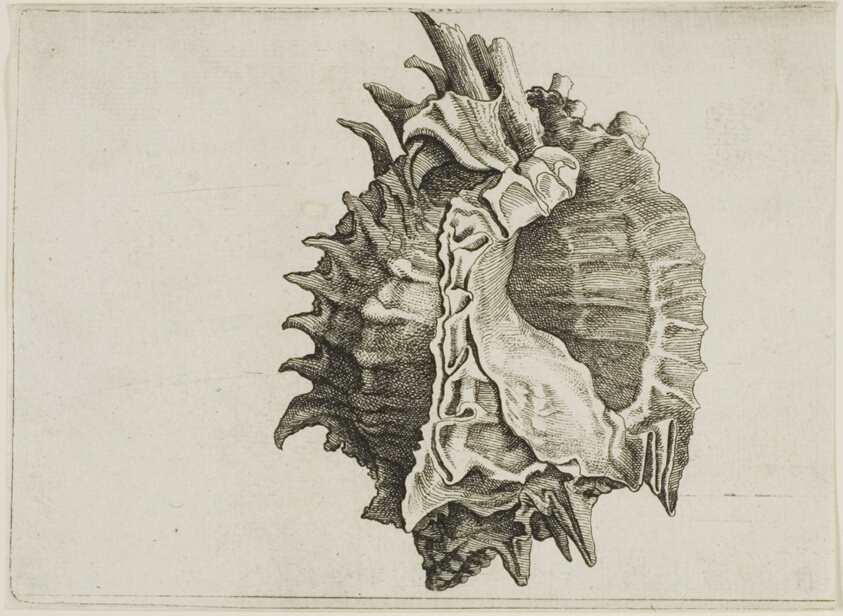
Pink-Mouth Murex (phyllonotus erythrostomus)
Wenceslaus HollarLinkedCulture matchlcp-ec5e0c654fff
- Date
- c. 1646
- Medium
- Etching on ivory laid paper
- Culture
- Bohemia
- Department
- Prints and Drawings
- Institution
- Art Institute of Chicago
- Object ID
- 145833
From the Art Institute of Chicago record
In the 17th century, seashells became popular collectible objects because they were considered rare and exotic. They also became common subjects for still-life paintings known as Vanitas, which symbolically represent the transience of life. The etchings of both Wenceslaus Hollar and Rembrandt van Rijn could represent the simultaneous beauty and fragility of existence. While still lifes in general are exceedingly rare in Rembrandt’s work, Hollar’s etching comes from a series of seashells, consisting of 38 plates. Rembrandt’s shell (1938.1805) could have been inspired by Hollar’s work, though Rembrandt’s decision to render the shell in a three-dimensional space represents a marked difference between the two etchings.
The authoritative record is held by Art Institute of Chicago. LinkedCulture surfaces this object and its connections; it does not alter institutional metadata.
Get printable QR codesHide QR codes
Open QR codes for this object page and the museum record. They stay collapsed until needed.
Provenance & credit
As published by the source institution. Coverage varies — not every institution's open-data feed includes ownership history.
- Credit line
- Celia and David Hilliard Endowment
Linked open data
Authority identifiers that link this record into the wider web of cultural data — stable references you can follow to the source.
- Object type
- AAT300041273
Related across collections
Semantically similar works from Art Institute of Chicago and other institutions.