Art Institute of Chicago
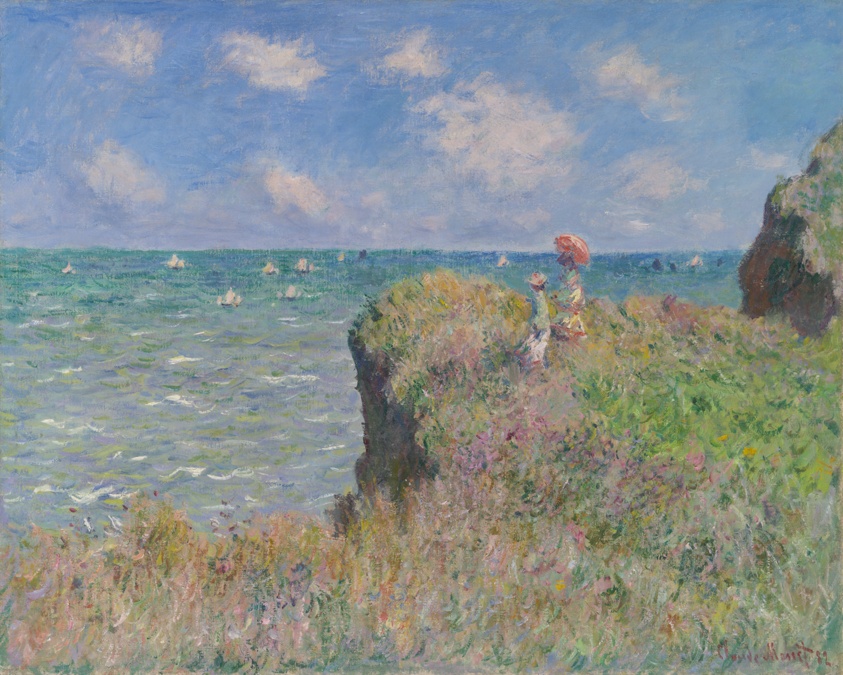
Cliff Walk at Pourville
Claude Monet (French, 1840–1926)LinkedCulture matchlcp-8e614afd9c71
- Date
- 1882
- Medium
- Oil on canvas
- Culture
- France
- Department
- Painting and Sculpture of Europe
- Institution
- Art Institute of Chicago
- Object ID
- 14620
In February 1882, Claude Monet went to Normandy to paint, one of many such expeditions that he made in the 1880s. This was also a retreat from personal and professional pressures. His wife, Camille, had died three years earlier, and Monet had entered into a domestic arrangement with Alice Hoschedé (whom he would marry in 1892, after her husband's death). France was in the midst of a lengthy economic recession that affected Monet's sales. In addition, the artist was unenthusiastic about the upcoming seventh Impressionist exhibition—divisions within the group had become pronounced by this time—and he delegated the responsibility for his contribution to his dealer, Paul Durand-Ruel. Disappointed in the area around the harbor city of Dieppe, which he found too urban, Monet settled in Pourville and remained in this fishing village until mid-April. He became increasingly enamored of his surroundings, writing to Hoschedé and her children: "How beautiful the countryside is becoming, and what joy it would be for me to show you all its delightful nooks and crannies!" He was able to do so in June, when they joined him in Pourville.The two young women strolling in Cliff Walk at Pourville are probably Marthe and Blanche, the eldest Hoschedé daughters. In this work, Monet addressed the problem of inserting figures into a landscape without disrupting the unity of its painterly surface. He integrated these elements with one another through texture and color. The grass—composed of short, brisk, curved brushstrokes—appears to quiver in the breeze, and subtly modified versions of the same strokes and hues suggest the women's wind-whipped dresses and shawls and the undulation of the sea. X-radiographs show that Monet reduced the rocky outcropping at the far right to balance the proportions of sea and sky.
The authoritative record is held by Art Institute of Chicago. LinkedCulture surfaces this object and its connections; it does not alter institutional metadata.
Get printable QR codesHide QR codes
Open QR codes for this object page and the museum record. They stay collapsed until needed.
Provenance & credit
As published by the source institution. Coverage varies — not every institution's open-data feed includes ownership history.
- Credit line
- Mr. and Mrs. Lewis Larned Coburn Memorial Collection
- Provenance
- Hayes, by Mar. 1, 1883 [per Galeries Durand-Ruel 1883]. Hermann Kapferer, Paris, by July 17, 1888 [per Durand-Ruel, Paris, stock book for 1888 (no. 1687), as confirmed by Paul-Louis Durand-Ruel and Flavie Durand-Ruel, Durand-Ruel Archives, to the Art Institute of Chicago, Oct. 5, 2010, curatorial object file. Wildenstein 1996 does not include Hermann Kapferer in the painting’s provenance and claims that Durand-Ruel purchased the painting from Monet in October 1882; the Durand-Ruel Archives are unable to support this claim]; sold to Durand-Ruel, Paris, July 17, 1888, for 1,200 francs [per Durand-Ruel, Paris, stock book for 1888 (no. 1687), as confirmed by Paul-Louis Durand-Ruel and Flavie Durand-Ruel, Durand-Ruel Archives, to the Art Institute of Chicago, Oct. 5, 2010, curatorial object file. Wildenstein 1996 does not include this in the provenance]; possibly sold to Annie Swan Coburn (d. 1932), Chicago, by Apr. 26, 1928 [per Art Institute of Chicago 1932. There is a notation on the Art Institute’s Museum Registration Department Artists Sheets that reads, “Durand-Ruel 995 4/26/28,” and one on receipt 5300 that states “P995 D-R Ap ’26.” This sale cannot be confirmed with the Durand-Ruel Archives, Paul-Louis Durand-Ruel and Flavie Durand-Ruel, Durand-Ruel Archives, to the Art Institute of Chicago, Oct. 5, 2010, curatorial object file]; bequeathed to the Art Institute of Chicago, 1933.
Linked open data
Authority identifiers that link this record into the wider web of cultural data — stable references you can follow to the source.
- Object type
- AAT300033618
Related across collections
Semantically similar works from Art Institute of Chicago and other institutions.