Art Institute of Chicago
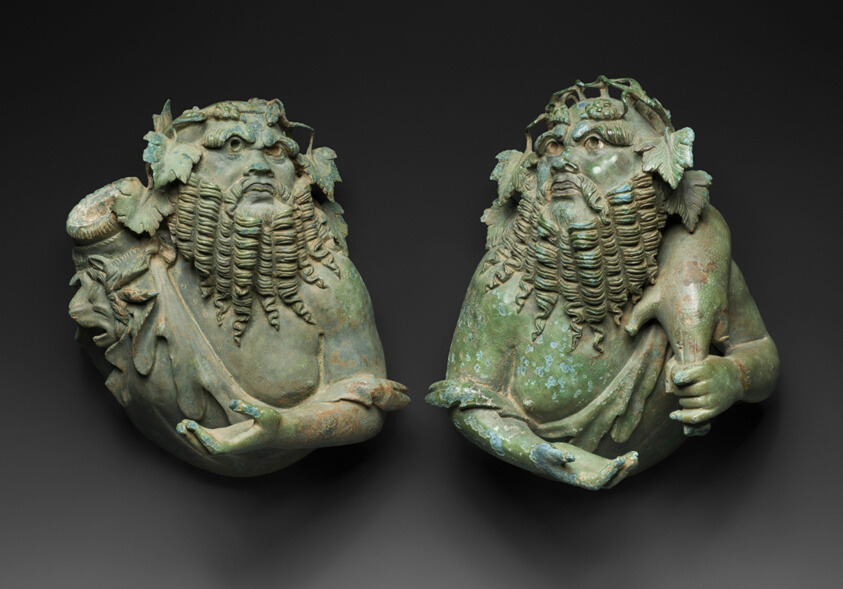
Attachments Depicting Busts of Silenoi
RomanLinkedCulture matchlcp-e70b76de214d
- Date
- Mid 1st century BCE-mid 1st century CE
- Medium
- Bronze, silver, and copper
- Culture
- Roman Empire
- Department
- Arts of Greece, Rome, and Byzantium
- Institution
- Art Institute of Chicago
- Object ID
- 147877
From the Art Institute of Chicago record
The Greek imagination was populated with a number of strange creatures. When their thoughts turned to wine, Greeks pictured mischievous young satyrs, the half- human, half-horse creatures who frolicked, danced, and chased hapless maenads. Satyrs symbolized suppressed hedonistic desires that were unleashed by the intoxicating elixir of the wine god Dionysos, known to the Romans as Bacchus. These creatures are mature satyrs, or silenoi (sing. silenos), and they once served as decorative elements for a type of couch on which elite, well-to-do Romans reclined at lavish banquets. Because wine was served at these festive events, creatures from Dionysos’s entourage were popular subjects for such furniture attachments. Each object is made of two pieces that were cast separately and fastened together. The proper right arm of the left silenos is lost, but the right one retains his separately made left arm. It and the wineskin slung over the corresponding shoulder were cast as one piece. The sclerae, or whites of their eyes, are silver, as are their teeth; furthermore, their lips were once inlaid with copper. Their remarkably animated facial expressions, with their furrowed brows and slightly parted lips, can be read as conveying pathos, perplexity, or perhaps inebriated befuddlement.
The authoritative record is held by Art Institute of Chicago. LinkedCulture surfaces this object and its connections; it does not alter institutional metadata.
Get printable QR codesHide QR codes
Open QR codes for this object page and the museum record. They stay collapsed until needed.
Provenance & credit
As published by the source institution. Coverage varies — not every institution's open-data feed includes ownership history.
- Credit line
- Katherine K. Adler Memorial Fund
- Provenance
- Robert Hecht (1919–2012), New York, by 1957 [this and the following according to correspondence from Cornelius Vermeule III, dated 1997; copy in curatorial object file]; sold through Hesperia Fine Arts, to a private collection, Philadelphia; with Roberth Hecht, New York; sold to the Art Institute of Chicago, 1997.
Linked open data
Authority identifiers that link this record into the wider web of cultural data — stable references you can follow to the source.
- Object type
- AAT300411641
Related across collections
Semantically similar works from Art Institute of Chicago and other institutions.