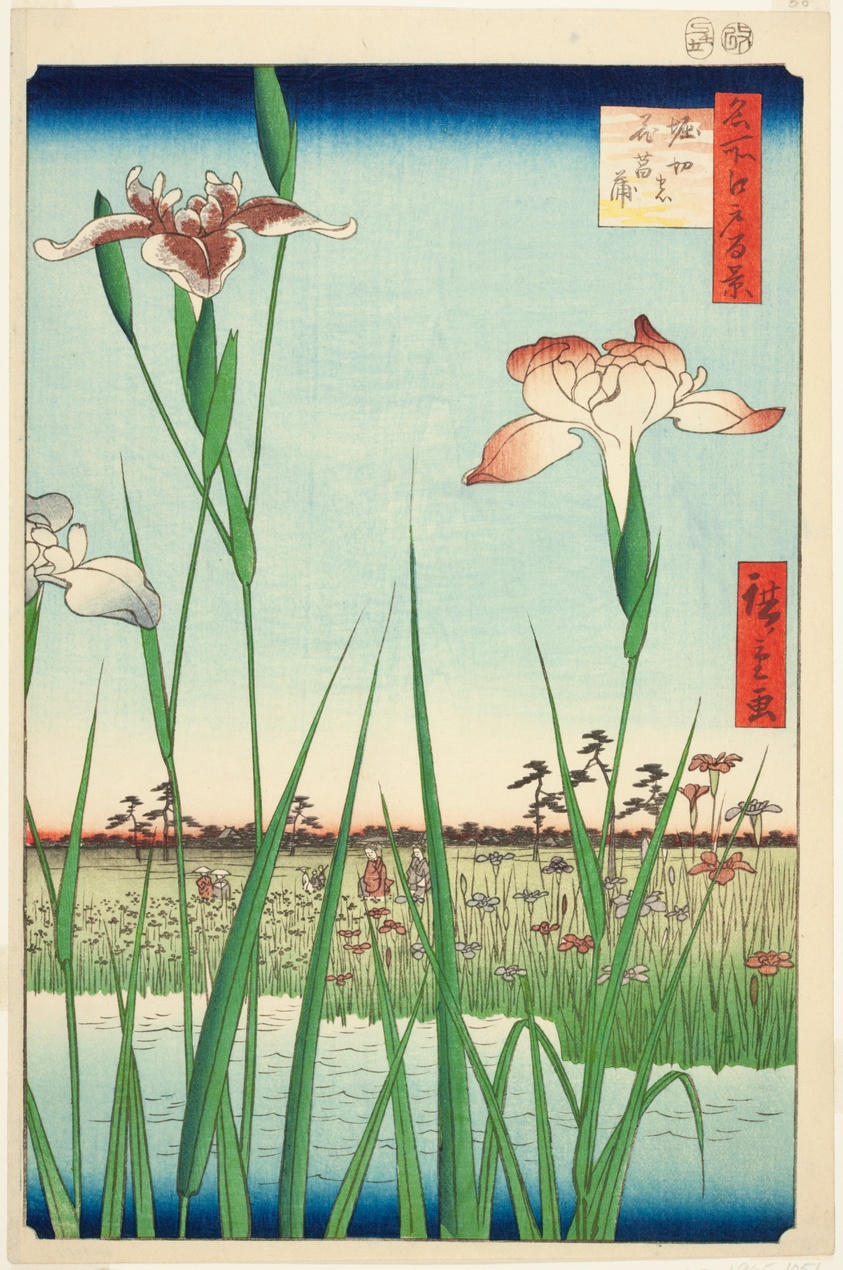
Irises at Horikiri (Horikiri no hanashobu), from the series "One Hundred Famous Views of Edo (Meisho Edo hyakkei)"

Art Institute of Chicago

Irises at Horikiri (Horikiri no hanashobu), from the series "One Hundred Famous Views of Edo (Meisho Edo hyakkei)"

Utagawa Hiroshige 歌川 広重

Date
1857
Medium
Color woodblock print; oban
Culture
Japan
Department
Arts of Asia
Institution
Art Institute of Chicago

The suburb of Horikiri was famous for its marshy land and flower cultivation, and the hanashōbu iris seen here was its most well-known product. Hanashōbu irises were popular not only in Edo (now Tokyo) but also in the West: German botanist and physician Philipp von Siebold brought them to Europe in the 1850s. Popular images like this one made the flower a symbol of Japan. The printer used glorious purples and delicate gradation to depict the flowers in this print, considered an iconic representation of nature in Japanese art. This version is a well-preserved first edition of the design.

The authoritative record is held by Art Institute of Chicago. LinkedCulture surfaces this object and its connections; it does not alter institutional metadata.

Related across collections

Semantically similar works from Art Institute of Chicago and other institutions.

Irises at Horikiri

Irises at Horikiri

Minneapolis Institute of Art

Irises at Horikiri

Irises at Horikiri

Minneapolis Institute of Art

Irises at Horikiri (Horikiri no hanashobu), from the series "One Hundred Famous Views of Edo (Meisho Edo hyakkei)"

Irises at Horikiri (Horikiri no hanashobu), from the series "One Hundred Famous Views of Edo (Meisho Edo hyakkei)"

Art Institute of Chicago

Irises at Horikiri (Horikiri no hanashobu), from the series "One Hundred Famous Views of Edo (Meisho Edo hyakkei)"

Irises at Horikiri (Horikiri no hanashobu), from the series "One Hundred Famous Views of Edo (Meisho Edo hyakkei)"

Art Institute of Chicago

Irises at Horikiri (Horikiri no hanashobu), from the series "One Hundred Famous Views of Edo (Meisho Edo hyakkei)"

Irises at Horikiri (Horikiri no hanashobu), from the series "One Hundred Famous Views of Edo (Meisho Edo hyakkei)"

Art Institute of Chicago

Irises at Horikiri (Horikiri no hanashobu), from the series "One Hundred Famous Views of Edo (Meisho Edo hyakkei)"

Irises at Horikiri (Horikiri no hanashobu), from the series "One Hundred Famous Views of Edo (Meisho Edo hyakkei)"

Art Institute of Chicago

Iris at Horikiri Village (Horikiri no sato hanashobu), section of a sheet from the series "Cutout Pictures of Famous Places in Edo (Edo meisho harimaze zue)"

Iris at Horikiri Village (Horikiri no sato hanashobu), section of a sheet from the series "Cutout Pictures of Famous Places in Edo (Edo meisho harimaze zue)"

Art Institute of Chicago

Temple Gardens in Nippori (Nippori jiin no rinsen), from the series "One Hundred Famous Views of Edo (Meisho Edo hyakkei)"

Temple Gardens in Nippori (Nippori jiin no rinsen), from the series "One Hundred Famous Views of Edo (Meisho Edo hyakkei)"

Art Institute of Chicago

Temple Gardens in Nippori (Nippori jiin no rinsen), from the series "One Hundred Famous Views of Edo (Meisho Edo hyakkei)"

Temple Gardens in Nippori (Nippori jiin no rinsen), from the series "One Hundred Famous Views of Edo (Meisho Edo hyakkei)"

Art Institute of Chicago

Horie and Nekozane, from the series “One Hundred Famous Views of Edo (Meisho Edo hyakkei)”

Horie and Nekozane, from the series “One Hundred Famous Views of Edo (Meisho Edo hyakkei)”

Art Institute of Chicago

Horie and Nekozane, from the series "One Hundred Famous Views of Edo (Meisho Edo hyakkei)"

Horie and Nekozane, from the series "One Hundred Famous Views of Edo (Meisho Edo hyakkei)"

Art Institute of Chicago

Fukagawa Susaki and Jumantsubo (Fukagawa Susaki Jumantsubo), from the series "One Hundred Famous Views of Edo (Meisho Edo hyakkei)"

Fukagawa Susaki and Jumantsubo (Fukagawa Susaki Jumantsubo), from the series "One Hundred Famous Views of Edo (Meisho Edo hyakkei)"

Art Institute of Chicago