Art Institute of Chicago
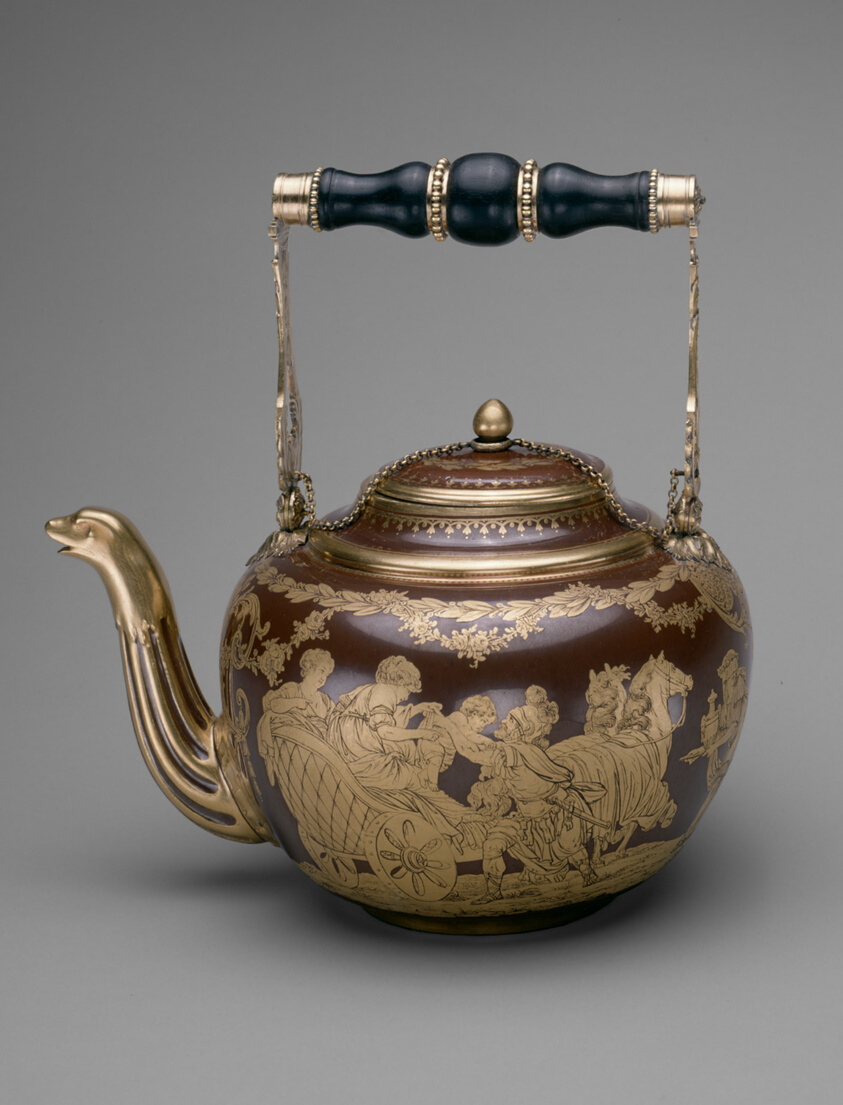
Kettle
Sèvres Porcelain ManufactoryLinkedCulture matchlcp-ee31089ce69a
- Date
- 1783/84
- Medium
- Hard-paste porcelain, brown ground (fond laque), black enamel, and gilding; silver-gilt and ebony mounts
- Culture
- Sèvres
- Department
- Applied Arts of Europe
- Institution
- Art Institute of Chicago
- Object ID
- 151398
From the Art Institute of Chicago record
This kettle, made at the Sèvres porcelain manufactory outside Paris, illustrates a story recounted by the ancient Roman historian Titus Livius, known in English as Livy. In 390 B.C., when Rome was under siege, a plebeian (commoner) named Albinius was fleeing the city, transporting his family in a cart. He encountered the vestal virgins, the guardian priestesses of the sacred flame of Rome, who were escaping on foot carrying their ritual vessels. Albinius offered his cart to the priestesses, thus performing a noble deed exhibiting both piety and gravitas, or seriousness of purpose. The kettle is hard-paste porcelain, made from a mixture of kaolin (white clay made from broken down feldspathic rock) and petuntse (chinastone) that is glazed with powdered feldspar and fired at high temperatures (about 2372° F, or 1300° C). The porcelain is covered with a deep brown glaze, called fond laque (literally “lacquer glaze”) for its resemblance to lacquer. The painters at Sèvres developed this technique in about 1780. The figures, in matte gold and outlined in black enamel, are called figures étrusques (Etruscan figures) in Sèvres’ records, an allusion to the ancient vases that were so fashionable in the Neoclassical era.
The authoritative record is held by Art Institute of Chicago. LinkedCulture surfaces this object and its connections; it does not alter institutional metadata.
Get printable QR codesHide QR codes
Open QR codes for this object page and the museum record. They stay collapsed until needed.
Provenance & credit
As published by the source institution. Coverage varies — not every institution's open-data feed includes ownership history.
- Credit line
- Harry and Maribel G. Blum, Annette M. Chapin, Kay and Frederick Krehbiel, and Mr. and Mrs. Joseph Varley endowments; through prior acquisition of Richard T. Crane, Jr.
Linked open data
Authority identifiers that link this record into the wider web of cultural data — stable references you can follow to the source.
- Object type
- AAT300386308
Related across collections
Semantically similar works from Art Institute of Chicago and other institutions.